
I’m not a veterinary nutritionist. I can help you compare ingredient lists and spot patterns in recall data, but your vet should be the one guiding dietary decisions for your dog, whether they have health conditions or not. This article is for informational purposes only and does not constitute veterinary advice.
When researching dog food brands to avoid, the patterns in FDA recall data are hard to ignore. Over the past several years, I’ve tracked label claims, recall notices and guaranteed analysis numbers on dozens of commercial dog food brands, logging everything in a spreadsheet alongside my three dogs’ weight, coat condition and stool quality. Certain brands show up on FDA recall lists over and over, use vague protein sourcing that makes real comparison impossible, and lean on cheap carbohydrates that add calories without proportional nutritional value.
Bottom line: not all dog food brands are equal, and price doesn’t predict quality. Several widely available brands have documented recall histories, questionable ingredient sourcing and formulas that appear to prioritize shelf stability over what your dog actually needs. The dog food brands to avoid most frequently flagged by the FDA and independent testing include Ol’ Roy, Alpo, Pedigree, Gravy Train, Kibbles ‘n Bits and Beneful. Below is what the public record shows and how to evaluate any brand yourself.
Part of: Dog Food Selection Guide – How to Pick the Right Food
Dog Food Brands to Avoid: The Complete List
The dog food brands to avoid share a common pattern: unnamed protein sources, synthetic preservatives with documented safety concerns, and carbohydrate-heavy formulas. Knowing which dog food brands to avoid starts with understanding their track records. Here are the ones with the most consistent problems.
Sportmix, Pro Pac, Splash (Midwestern Pet Foods)
Among dog food brands to avoid, this group stands out as the most severe. In late 2020 and early 2021, Midwestern Pet Foods recalled multiple product lines after aflatoxin contamination was linked to over 110 pet deaths and 210 reported illnesses according to FDA enforcement records. Aflatoxin is a mold-produced toxin that causes liver failure. The FDA found “egregiously insanitary conditions” at the company’s manufacturing facility. If there’s a single brand history that justifies checking the FDA recall database before buying, it’s this one.
Ol’ Roy (Walmart store brand)
Ol’ Roy consistently ranks among the top dog food brands to avoid in my analysis. Multiple recalls for inadequate vitamin and mineral levels, plus potential salmonella contamination. As of early 2026, the label typically lists corn as the first ingredient with “meat and bone meal” as the protein source. That tells you almost nothing about what animal it came from. In the ingredient comparisons I’ve done across budget brands, Ol’ Roy scored lowest.
Gravy Train, Kibbles ‘n Bits, Skippy (J.M. Smucker brands)
These are dog food brands to avoid due to a disturbing 2018 recall after pentobarbital, a euthanasia drug, was detected in samples. The contamination was traced to rendered animal by-products in the supply chain. J.M. Smucker has had multiple FDA recall actions across these brands since 2015, including a 2018 withdrawal affecting all three product lines.
Pedigree (Mars Petcare)
Pedigree appears on most lists of dog food brands to avoid for good reason. Multiple FDA recall actions for foreign material contamination and loose metal fragments since 2015. As of early 2026, corn, wheat and soy appear high on the label in most of their formulas.
Alpo (Purina)
Alpo belongs among dog food brands to avoid with multiple FDA recall actions over the past decade. As of early 2026, the label consistently shows animal meal, artificial colors like Red 40 and Yellow 5, and added sugar. None of those serve a nutritional purpose your dog can’t get from better sources.
Pro tip from Liora: Keep a screenshot of your dog’s current food label on your phone. When you’re comparing brands at the store, you can pull it up and check the first five ingredients side by side in about 30 seconds.
Beneful (Purina)
Beneful is among the dog food brands to avoid that was the subject of a class action lawsuit (Lucido v. Nestle Purina) alleging propylene glycol and mycotoxin contamination. The court dismissed the case, but as of early 2026, the current formula still lists corn gluten meal, added sugar and artificial colors.
Brands Named in the FDA DCM Investigation
In 2018, the FDA began investigating a potential link between certain dog food brands and dilated cardiomyopathy (DCM) in dogs. The sixteen brands that appeared most frequently in the reports were:
- Acana
- Zignature
- Taste of the Wild
- 4Health
- Earthborn Holistic
- Blue Buffalo
- Nature’s Domain
- Fromm
- Merrick
- California Natural
- Natural Balance
- Orijen
- Nature’s Variety
- NutriSource
- Nutro
- Rachael Ray Nutrish
Most of these were grain-free formulas with peas, lentils and chickpeas as primary carbohydrate sources. The catch is that as of early 2026, the FDA has not established a definitive causal link between these brands and DCM. The data suggests a correlation worth monitoring, not a confirmed verdict. I stopped feeding my dogs a grain-free formula after discussing this research with my vet, but I wouldn’t put every brand on that list in the same category as the dog food brands to avoid with repeated contamination recalls.
For more on the grain side of this debate, the grain-free dog food debate covers what the research actually says.
Why These Dog Food Brands to Avoid Keep Getting Recalled
The dog food brands to avoid on this list share structural problems, not just isolated manufacturing failures. Most rely on rendered ingredients from unnamed animal sources, which makes supply chain quality control harder to maintain. When a manufacturer doesn’t specify the protein source on the label, they’re likely sourcing from multiple suppliers with varying quality standards. That variability is where contamination enters the chain.
Cost-cutting drives most of it. Artificial preservatives like BHA and BHT are cheaper than natural alternatives like mixed tocopherols (vitamin E). Corn and wheat filler costs a fraction of named animal protein. According to the National Toxicology Program, BHA is “reasonably anticipated to be a human carcinogen” based on laboratory animal studies; the International Agency for Research on Cancer classifies it as a Group 2B possible carcinogen. The safety margin for dogs hasn’t been as extensively studied, but the preservative serves the manufacturer’s shelf life needs, not your dog’s nutritional needs.
The pattern becomes clear when you track dog food brands to avoid over time: the same parent companies appear repeatedly. That’s not bad luck. That’s a sourcing and quality control philosophy showing up in the data.
Red Flag Ingredients in Dog Food Brands to Avoid
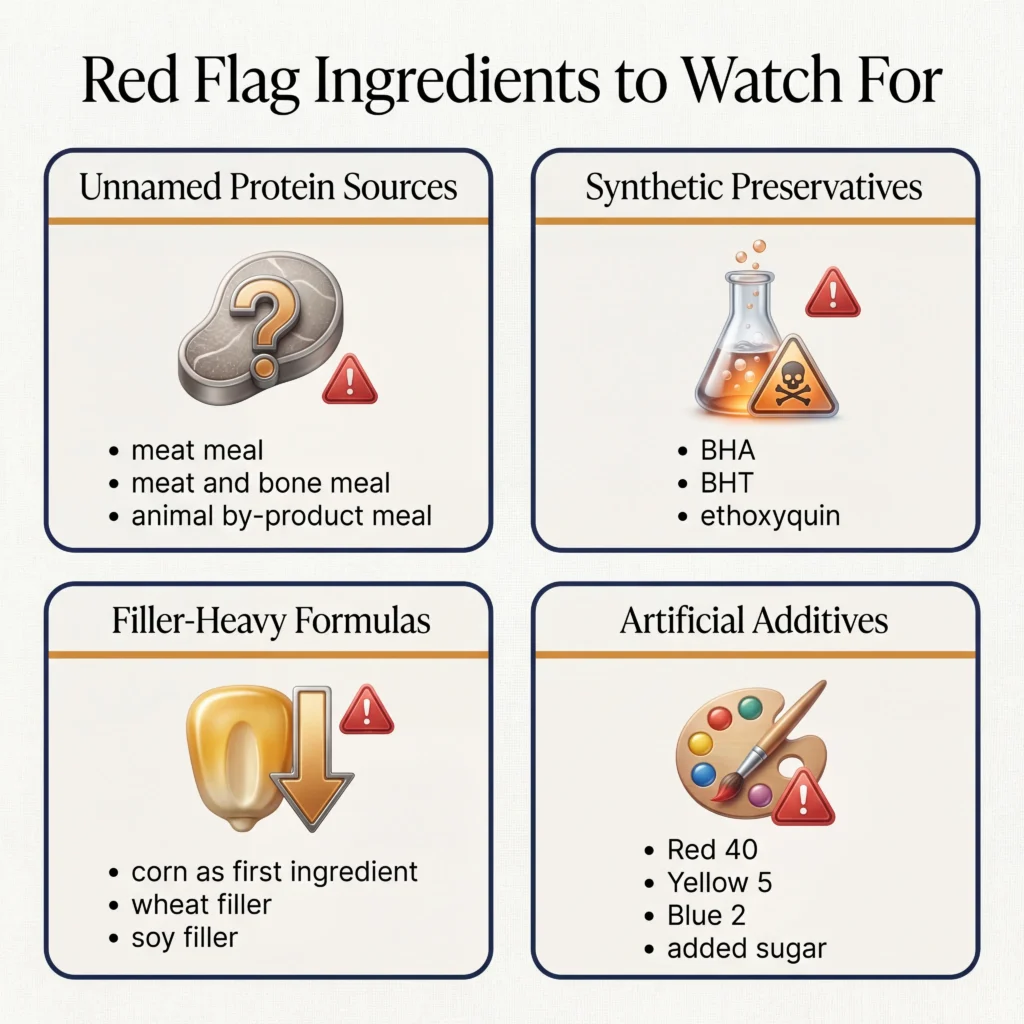
You don’t need to memorize a list of dog food brands to avoid. Learning to read a label takes about 60 seconds and gives you a more reliable tool than any “worst brands” article, including this one.
Unnamed protein sources: “Meat meal,” “meat and bone meal” or “animal by-product meal” without specifying the animal means the manufacturer either doesn’t know or doesn’t want to disclose their protein source. Compare that to “chicken meal” or “salmon meal,” where you at least know the species. Named by-products like “chicken by-products” include organ meats that can be nutrient-dense. Unnamed ones from unspecified animals are where quality becomes unpredictable.
Synthetic preservatives: BHA, BHT and ethoxyquin (originally developed as a pesticide stabilizer) show up in lower-cost dry food. Mixed tocopherols serve the same preservative function without the safety questions. These ingredients are common in dog food brands to avoid.
Filler-heavy formulas: When corn, wheat or soy appear as the first or second ingredient, the recipe is built around cheap carbohydrates for bulk. I tracked my dogs’ stool quality and coat condition when switching from a corn-heavy formula to one with whole chicken and brown rice in the top three positions. My spreadsheet showed measurable differences within two weeks.
Artificial colors and sweeteners: Red 40, Yellow 5, Blue 2 and added sugar. These exist for marketing (making the food look appealing to the human buying it), not for the dog eating it. Any brand using these belongs among dog food brands to avoid.
Most Recalled Dog Food Brands to Avoid
Not all recalls signal a fundamentally bad product. A single recall for a packaging error is different from five recalls for salmonella over a decade. The pattern matters more than a single incident when identifying dog food brands to avoid.
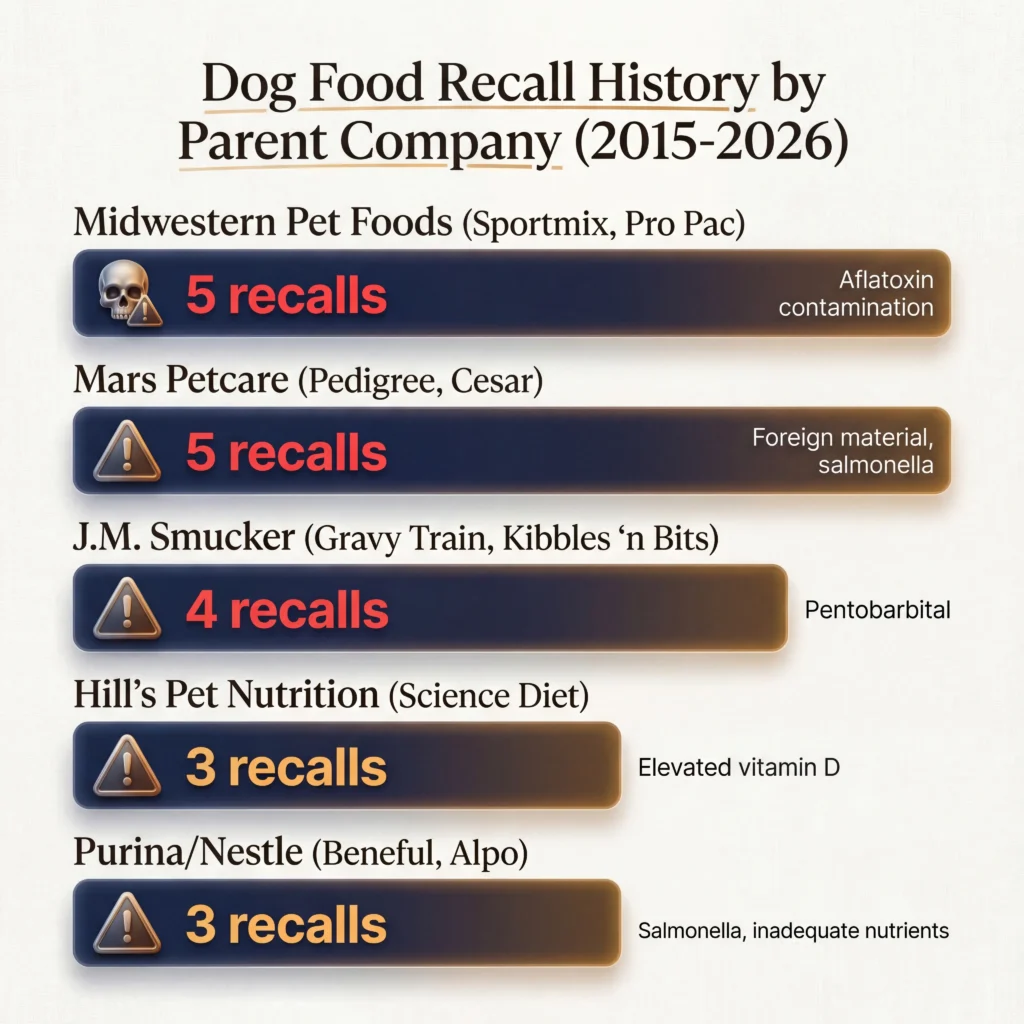
| Parent Company | Brand(s) | Recall Actions (2015-2026) | Most Common Reason |
|---|---|---|---|
| Midwestern Pet Foods | Sportmix, Pro Pac, Splash | 5 (including 2020-2021 aflatoxin) | Aflatoxin contamination (linked to 110+ pet deaths) |
| Mars Petcare | Pedigree, Cesar, Nutro | 5 | Foreign material, potential salmonella |
| J.M. Smucker | Gravy Train, Kibbles ‘n Bits | 4 | Pentobarbital, elevated thyroid hormone |
| Hill’s Pet Nutrition | Science Diet, Prescription Diet | 3 | Elevated vitamin D (toxic levels) |
| Purina (Nestle) | Beneful, Alpo, Purina ONE | 3 | Salmonella, inadequate nutrients |
Data compiled from FDA recall database. Counts reflect publicly listed recall actions; actual enforcement activity may differ. Current as of March 2026.
Hill’s is worth noting separately when discussing dog food brands to avoid. Their 2019 recall for elevated vitamin D affected multiple product lines and was linked to actual pet injuries. The company is generally well-regarded by veterinarians, which shows that even brands with strong reputations can have manufacturing failures. My vet still recommends Hill’s for therapeutic diets. The recall was a production error, not a formulation philosophy problem.
You can check any brand’s recall history through the FDA’s recall database. I check it quarterly to update my list of dog food brands to avoid.
Signs Your Dog Is Eating One of the Dog Food Brands to Avoid
Your dog can’t tell you the food isn’t working, but their body does. If you’re feeding one of the dog food brands to avoid, these are the signals to watch for. I tracked these across my three dogs when switching formulas, and they’re the same ones my vet told me to monitor.
Digestive signs: Persistent loose stools or diarrhea that lasts more than two to three days after a transition period. Excessive gas. Vomiting after meals (not the occasional grass-eating episode, but a pattern).
Coat and skin: Dull, dry coat that doesn’t improve with grooming. Excessive scratching or licking without an obvious external cause like fleas. Flaky skin along the back or behind the ears.
Energy and weight: Unexplained weight gain or loss without changes in portion size or activity level. Low energy or lethargy that doesn’t match your dog’s normal temperament.
The timeline matters. When I switched one of my senior dogs off a grain-free formula (one of the dog food brands to avoid in the DCM investigation), I logged daily observations. Stool quality improved within four days. Coat changes took closer to three weeks to become visible. If you notice any of these signs, your vet can run bloodwork and recommend an elimination diet to pinpoint the issue. Don’t try to diagnose it by swapping foods randomly.
How to Identify Dog Food Brands to Avoid Yourself
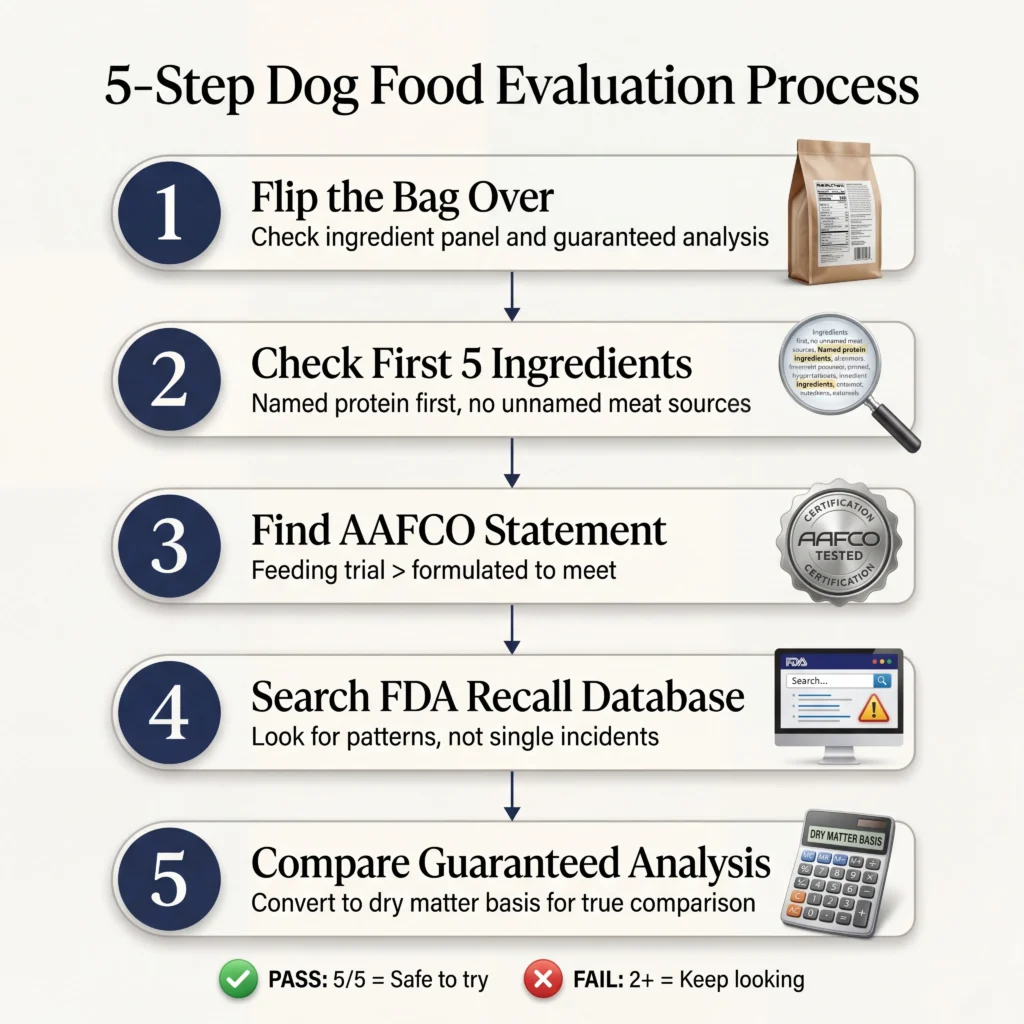
Waiting for someone to publish an updated list of dog food brands to avoid isn’t a long-term strategy. Brands reformulate. New recalls happen. Here’s how to assess any dog food in under five minutes.
Step 1: Flip the bag over. The front is marketing. The label and guaranteed analysis on the back are where the actual information lives.
Step 2: Check the first five ingredients. These make up the bulk of the food by weight. You want a named animal protein (chicken, beef, salmon) in the first position. If the first ingredient is corn or wheat, or if the protein source says “meat meal” without specifying an animal, add it to your personal list of dog food brands to avoid.
Step 3: Find the AAFCO statement. One version says the food was tested on actual dogs through feeding trials. The other says it was designed on paper to meet nutritional profiles but never tested in practice. The feeding trial version is a stronger quality signal.
Step 4: Search the brand on the FDA recall database. Takes 30 seconds. You want to see either no results or a single isolated incident, not a repeating pattern that would put it among dog food brands to avoid.
Step 5: Compare the guaranteed analysis on a dry matter basis. Protein minimums on the label aren’t directly comparable between wet and dry food. Subtract the moisture percentage from 100, then divide the protein percentage by that number. A wet food listing 10% protein with 78% moisture has roughly 45% protein on a dry matter basis; a dry food listing 26% protein with 10% moisture has about 29%. The wet food actually has more protein per serving despite the lower label number.
Pro tip from Liora: Screenshot the guaranteed analysis and the first ten ingredients before leaving the store. It takes ten seconds and saves you from having to go back when you’re comparing at home.
If a brand passes all five checks, it’s probably fine regardless of whether it shows up on someone’s list of dog food brands to avoid. If it fails two or more, keep looking.
What Cheap Dog Food Brands to Avoid Actually Cost You
A $25 bag of dry food that lasts three weeks looks cheaper than a $50 bag that lasts five weeks. On a cost-per-day basis, the difference is $1.19 versus $1.43 (as of early 2026 pricing at major US retailers). Less than a quarter per day.
But the real cost comparison isn’t bag-to-bag. It’s food cost versus vet bills over time. Dogs fed dog food brands to avoid develop more skin issues, digestive problems and dental disease over their lifetimes. A single vet visit for chronic diarrhea with bloodwork runs $200-400 based on national veterinary cost averages. An allergy workup with an elimination diet protocol can run $500-1,000 over several months.
I’m not claiming that avoiding dog food brands to avoid prevents all health problems. Genetics and environment matter more than any single dietary choice. But when I compare what I pay per day for a brand with named protein, proof it was tested on actual dogs and a clean recall history against a budget brand with corn as the first ingredient and a pattern of FDA actions, the difference is usually $0.30-0.60 per day. That’s the cost of one bad coffee per week.
Alternatives to Dog Food Brands to Avoid
I’m not going to recommend specific brand names. This is an AdSense site, not an affiliate play, and what works for a 10-pound dog with allergies won’t work for a healthy 80-pound Lab. But I can give you the criteria that separate quality brands from dog food brands to avoid.
A solid dog food has a named animal protein as the first ingredient, an AAFCO feeding trial statement on the bag, no artificial colors or unnamed preservatives, and a recall history that’s either clean or limited to isolated incidents. When comparing options, what you pay per day matters more than what the bag costs. A $60 bag that feeds a dog for 45 days costs less per day than a $40 bag that lasts 20.
For puppies: Look for formulas specifically labeled for growth or all life stages with controlled calcium levels. Large-breed puppies need slower growth rates to protect joint development; I compared calcium levels across five large-breed formulas and found a range of 1.0% to 1.8%. Your vet can tell you the right range for your puppy’s breed.
For senior dogs: Higher protein to maintain muscle mass, lower calorie content to prevent weight gain as activity decreases. Joint-support ingredients like glucosamine are a bonus but not a substitute for veterinary care.
For dogs with allergies: An elimination diet under vet guidance is the only reliable way to identify the trigger. Specialty dog food formulas exist for a reason, but apply the same five-step evaluation to those brands too. Many hypoallergenic brands still fall among dog food brands to avoid.
For dogs with sensitive stomachs: Limited-ingredient formulas with a single named protein source tend to be easier to track. If your dog reacts badly to a food, having fewer ingredients makes it easier to isolate the problem. My younger rescue does best on a formula with four or five core ingredients rather than twenty.
Sable, who covers everyday food safety in her fruit and vegetable safety guides, is a good resource if you’re looking at fresh food supplements alongside commercial dry food. And if you’re considering freeze-dried raw dog food as a premium alternative to dog food brands to avoid, that guide breaks down whether the cost matches the quality.
How to Switch Your Dog Off Dog Food Brands to Avoid Safely
Don’t swap cold turkey. A sudden change in food can cause digestive upset even when you’re switching away from dog food brands to avoid. The transition should take seven to ten days. If your dog has existing health conditions, check with your vet before starting any food switch.
Days 1-3: 75% old food, 25% new food. Watch for any immediate digestive reaction.
Days 4-6: 50/50 mix. Most dogs adjust without issues by this point. Loose stools during this phase are normal and usually resolve within a day.
Days 7-10: 25% old food, 75% new food. By day 10, switch fully to the new formula.
If your dog has persistent vomiting or diarrhea beyond the first three days, stop the transition and call your vet. Some dogs with sensitive stomachs need a longer ramp, sometimes two to three weeks when switching from dog food brands to avoid. My younger rescue needed 14 days for her last food transition; the two seniors handled it in a week.
Keep portion sizes consistent during the switch. The new food may have different calorie content than the old one, so check the feeding guidelines on the new bag and adjust accordingly.
Frequently Asked Questions About Dog Food Brands to Avoid
What is the number one worst dog food brand to avoid?
Among dog food brands to avoid, Sportmix stands out by recall severity: aflatoxin contamination in 2020-2021 was linked to over 110 pet deaths according to FDA enforcement records. By ingredient quality in my comparisons, Ol’ Roy scored lowest across their full product line.
What dog food brands to avoid do vets recommend against?
Most vets I’ve spoken with include these dog food brands to avoid in their recommendations against: Pedigree, Alpo, Ol’ Roy and Kibbles ‘n Bits. Your vet’s recommendation should factor in your dog’s age, breed, weight and health conditions.
What ingredients indicate dog food brands to avoid?
Unnamed meat sources (“meat meal” or “animal by-product meal” without specifying the animal), BHA, BHT, ethoxyquin, artificial colors (Red 40, Yellow 5, Blue 2), added sugar and propylene glycol. These ingredients are hallmarks of dog food brands to avoid.
Is Blue Buffalo one of the dog food brands to avoid?
Blue Buffalo appears on the FDA’s DCM investigation list, but they’ve reformulated several product lines since then. Their labels vary significantly across formulas. Some are solid; others rely heavily on peas and lentils as primary ingredients. Check the specific formula you’re considering rather than automatically categorizing them among dog food brands to avoid.
What dog food brands to avoid have been recalled the most?
By parent company, the dog food brands to avoid with the most extensive recall records since 2015 are: Midwestern Pet Foods (Sportmix), Mars Petcare (Pedigree, Cesar) and J.M. Smucker (Gravy Train, Kibbles ‘n Bits).
Is grain-free dog food among dog food brands to avoid?
Not automatically, but the FDA’s investigation into a potential link between grain-free diets and DCM means caution is reasonable. I switched my three dogs back to grain-inclusive food after discussing the research with my vet. If your dog has a confirmed grain allergy, grain-free may still be appropriate.
How do I know if I’m feeding dog food brands to avoid?
Persistent loose stools, dull coat, excessive scratching, low energy or unexplained weight changes can all point to a food problem. Your vet can run bloodwork and recommend next steps if you suspect you’re feeding one of the dog food brands to avoid.
What is the healthiest alternative to dog food brands to avoid?
Several brands in the $1.50-2.50 per day range for a medium-sized dog (as of early 2026) offer named protein sources, proof of actual dog testing and clean recall histories. Look for whole chicken or chicken meal as the first ingredient, a statement saying the food was tested on dogs (not just “formulated to meet”), and no more than one FDA recall in the past five years.
The Bottom Line on Dog Food Brands to Avoid
A recall list goes stale. A label doesn’t. The dog food brands to avoid flagged in this article have documented histories that raise legitimate concerns, but your best long-term defense is learning to read the back of the bag yourself. I update the recall table as new FDA data comes in, so bookmark this page if you want the latest numbers on dog food brands to avoid.
Four things to do today:
- Flip your dog’s current food bag over and check the first five ingredients against the red flags in this article
- Search the brand in the FDA recall database and look for patterns that would put it among dog food brands to avoid
- Find the AAFCO statement and check whether it’s a feeding trial or a formulated-to-meet claim
- Compare one alternative brand using the five-step evaluation before your current bag runs out
That habit changes how you evaluate every dog food you’ll ever consider and helps you identify dog food brands to avoid on your own. For the full picture on choosing the right food for your dog’s specific needs, head back to the Dog Food Selection Guide.
This article is for informational purposes only and does not replace professional veterinary advice. If your dog has health conditions, consult a licensed veterinarian before making dietary changes.
- Liora Kittredge
