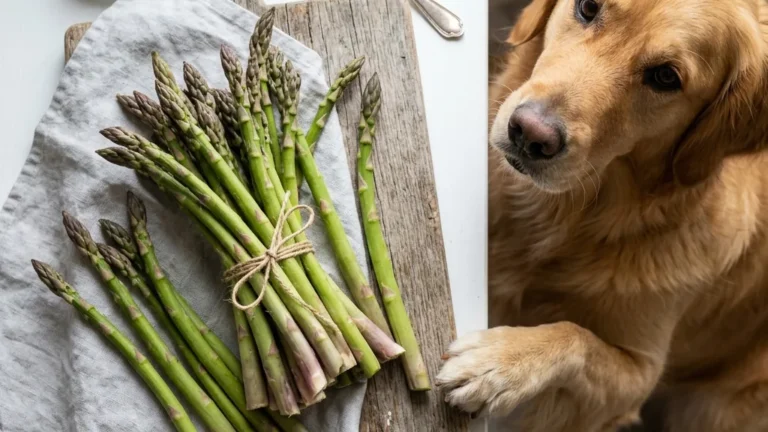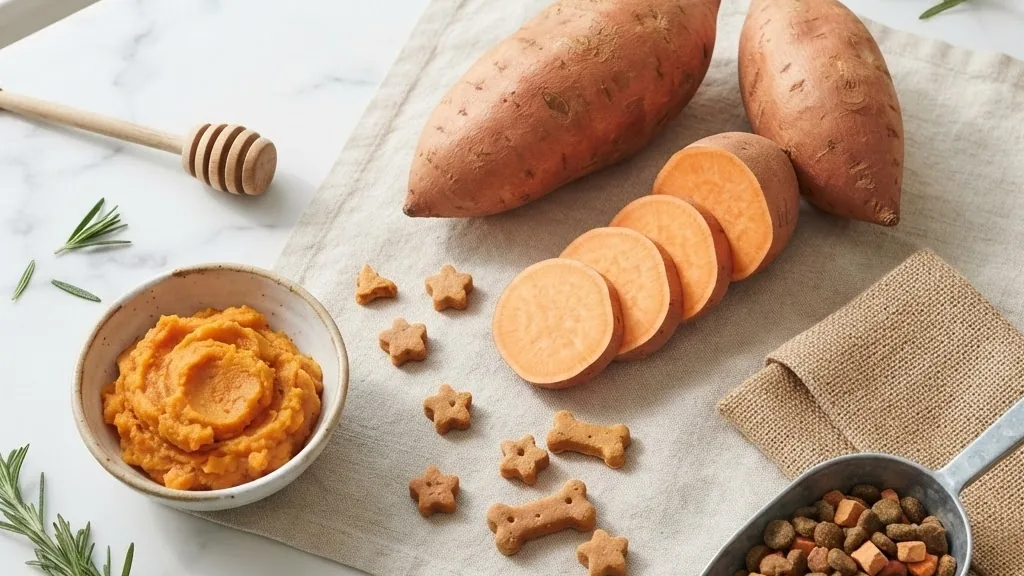
Are sweet potatoes good for dogs? Yes, cooked, plain, peeled, and served in moderation, this orange root is one of the safer human foods you can hand a healthy pup. The problem is that most quick answers stop there and skip the parts that matter: how baking nearly doubles the sugar, why raw pieces are a choking hazard, and what a multi-year federal heart investigation turned up inside grain-free recipes. This guide pulls real figures from USDA FoodData Central and the U.S. Food and Drug Administration instead of vague talk about fiber. If your dog also raids the vegetable drawer, our breakdown of safely serving asparagus to dogs covers a lower-carb option with similar rules.
Quick answer: Are sweet potatoes good for dogs in most cases? Yes. A plain, cooked, peeled sweet potato is a low-fat source of fiber, beta-carotene, and potassium, and dogs digest it well when it is soft and unseasoned. Keep it to a treat, never raw, never fried or buttered. Cooked sweet potato runs about 90 kcal per 100 grams, so a tablespoon for a small dog or a quarter cup for a large one stays inside the 10 percent treat limit. Skip it entirely if your dog is diabetic or forms urinary stones, and check with your vet first.
What Sweet Potatoes Actually Give Your Dog
A cooked sweet potato is mostly complex carbohydrate wrapped around a dense load of fiber, beta-carotene, and potassium. Per 100 grams, baked with the skin, it delivers roughly 90 kcal, about 20.7 grams of carbohydrate, 2 grams of protein, and only 0.15 grams of fat, according to USDA FoodData Central entry #168483. That near-zero fat is one reason vets reach for it in bland recovery diets. Color tells the rest of the story. The orange comes from beta-carotene, around 11,509 micrograms per 100 grams, which a dog’s body converts into roughly 961 micrograms RAE of vitamin A. A carrot lands near 835 micrograms RAE per 100 grams, so ounce for ounce this tuber out-carotenes the vegetable everyone links to vitamin A.
Vitamin A drives vision, immune function, and coat quality, and that is where most of the health claims start. There is more in the flesh than beta-carotene, though.
- Potassium: roughly 405 mg in a medium potato, with a potassium-to-sodium ratio near 13 to 1, useful for nerve and muscle function.
- Vitamin B6 and manganese: supporting metabolism and enzyme activity.
- Complex carbohydrate: steady energy rather than a fast spike.
A medium sweet potato is about 114 grams of flesh and roughly 103 kcal, so portion creep is easy when you eyeball it. The American Kennel Club (AKC) keeps a running list of vegetables dogs can eat, and sweet potato earns a spot when it is cooked and unseasoned. You can read their canine nutrition material over at the American Kennel Club if you want the broad picture.
Feeding it partly for the vitamin C? Remember that dogs synthesize their own, so it reads as a bonus rather than a requirement. That same bonus logic applies to fruit, which we unpack in our guide on whether dogs can eat oranges. The headline nutrient here is vitamin A from beta-carotene, and a spoonful of cooked sweet potato delivers plenty.
Cooked Versus Raw: Why Raw Is a Hard No
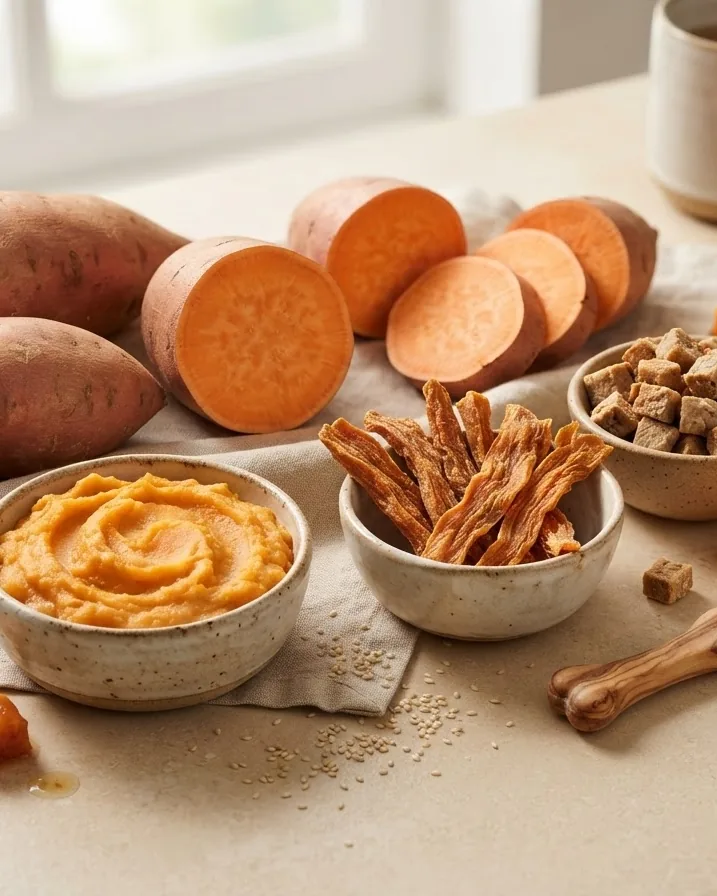
Never feed raw sweet potato to a dog. Uncooked, the root is dense and starchy, hard to chew, and hard to digest, and a chunk can lodge in the throat or the intestine as a choking or obstruction risk. Cooking softens the starch so the gut can break it down. Raw also carries slightly more calories than boiled, around 86 kcal per 100 grams versus about 76 kcal boiled without skin, but calories are not the reason to cook it. Texture is. Dogs bolt food, and a hard raw cube does not compress the way a soft cooked piece does, which is exactly the profile that turns into a windpipe or bowel emergency in a smaller dog.
There is no nutritional upside to raw that offsets that risk. Say it plainly: soft enough to mash with a fork, or it does not go in the bowl.
Swiped a raw slice off the counter? For a mid-size or large dog that is usually a watch-and-wait situation rather than a crisis. A whole chunk gulped by a toy breed is worth a phone call, because obstruction in a small gut moves fast. When in doubt, watch for retching, drooling, or a dog that cannot settle, and call.
Steamed, Boiled, or Baked: How Cooking Changes the Numbers
How you cook a sweet potato changes both its calories and its sugar. Boiling without the skin keeps it lowest at about 76 kcal per 100 grams. Baking with the skin concentrates it to around 90 kcal per 100 grams, and, more to the point, baking spikes the sugar. Raw sweet potato runs roughly 4.5 to 8.4 percent total sugars. Bake it, and an enzyme called beta-amylase converts starch into maltose, pushing total sugars to somewhere between 15.1 and 19.1 percent. That is why baked sweet potato tastes candy-sweet to us, and why an oven-cooked piece is a poorer pick for a dog watching its weight or its blood sugar.
Here is the same comparison laid out side by side, using the USDA figures already quoted above:
| Preparation | Calories per 100 g | Total sugars | Verdict for dogs |
|---|---|---|---|
| Raw | About 86 kcal | 4.5 to 8.4 percent | Never. Choking and obstruction risk outweighs everything else. |
| Boiled, peeled | About 76 kcal | Stays close to the raw range | Best pick, especially for diabetic or overweight dogs. |
| Baked, skin on | About 90 kcal | 15.1 to 19.1 percent | Fine as an occasional treat for a healthy dog; skip for sugar-sensitive ones. |
Steaming and boiling stay gentler on the sugar while keeping most of the beta-carotene, which is fat-soluble and reasonably heat-stable. For a healthy dog, the gap is minor. For a diabetic or overweight dog, it is the line between an okay treat and a bad one.
Skip the microwave shortcuts loaded with anything, and cool the flesh before serving. Warm mush is fine; hot mush burns a soft palate.
Peel On or Peel Off: The Fiber Debate
Peeling is the safer default, especially for small dogs and sensitive stomachs. The skin adds fiber, which sounds like a plus, but it is also tougher to digest and can sit heavy in a gut that already struggles. For a healthy large dog eating well-cooked, well-mashed pieces, leaving thin skin on is not dangerous. For a puppy, a senior, or any dog prone to loose stool or gas, take it off. The trade-off is real but small: a little extra fiber against a little extra digestive work. When you are introducing sweet potato for the first time, peel it, cook it soft, and serve a tiny amount so you can watch how your dog handles it before you scale up or experiment with the skin.
How Much Sweet Potato Per Dog, and the 10 Percent Rule
Portion is where good intentions go wrong. The core guideline is the 10 percent rule: treats, sweet potato included, should stay at or under 10 percent of your dog’s daily calories, with the other 90 percent coming from a complete, balanced food. Because cooked sweet potato lands near 90 kcal per 100 grams, small servings add up faster than people expect. A rough starting point is one tablespoon of cooked flesh for a small dog and a quarter to a half cup for a large one. Weigh your dog’s actual daily intake against those spoonfuls rather than free-feeding, because a medium potato alone is roughly 103 kcal and can blow past the treat allowance in one sitting.
Serve it plain. That word is doing heavy lifting.
- No salt, sugar, or butter.
- No marshmallow topping and no maple syrup.
- No garlic or onion, both of which are toxic to dogs.
- No pumpkin-pie spice blends, which often hide nutmeg.
Garlic and onion belong nowhere near the dish. The ASPCA Animal Poison Control Center keeps a maintained list of foods that harm dogs, and you can find the toxic-food guidance at the ASPCA. If you like structured serving ideas, mashed sweet potato smeared thin on a lick mat or spooned into a food toy turns a spoonful into a long, slow snack, which is a smarter delivery than one big bolus your dog inhales.
Are Sweet Potatoes Good for Dogs With Diabetes, Stones, or Weight Issues?
For some dogs the answer flips to no. For a diabetic dog, that kind of load can spike blood glucose, so it is a food to avoid or clear with a vet first. Overweight dogs face a simpler math problem, since roughly 90 kcal per 100 grams stacks up quickly on top of a full diet. Then there are oxalates. Sweet potato contains them, and in dogs prone to calcium oxalate urinary or kidney stones, oxalate-rich foods can feed stone formation, so a stone-forming history is a reason to leave it off the menu.
Three groups should be cautious or abstain:
- Diabetic dogs: the post-cooking sugar jump can destabilize blood glucose.
- Overweight dogs: the calorie density undercuts weight-loss plans.
- Stone-formers: oxalates may contribute to calcium oxalate stones in predisposed dogs.
Allergies to sweet potato exist but are uncommon, so they rank low on the worry list. A first serving still deserves attention: watch for itching, hives, vomiting, or diarrhea over the next day. Introduce it in a tiny amount, wait, and only build up if your dog stays comfortable.
Puppies and sick dogs sit in a gray zone too. A growing pup has different nutritional needs and a smaller margin for a rich treat, and a dog recovering from illness may be on a vet-directed plan that sweet potato does not fit. When a dog has a diagnosed condition, the sensible move is to ask the veterinarian before adding any new food, not after.
The FDA DCM Investigation and Heart Health
The one part almost no article covers is the heart question. In July 2018, the FDA Center for Veterinary Medicine (CVM) opened an investigation into a possible link between certain diets and dilated cardiomyopathy (DCM), a serious disease that weakens the heart muscle. Sweet potato got pulled into the story because it shows up as a filler in many grain-free formulas. A July 2019 update reported that more than 90 percent of the diets in reported cases were labeled grain-free, that 93 percent contained peas and/or lentils, and that 42 percent contained potatoes and/or sweet potatoes. Read that last figure carefully: it lumps white potatoes and sweet potatoes together, and the agency itself noted sweet potatoes alone showed up far less often than legumes. Peas were the pulse most implicated, not the orange root.
The scale is worth stating plainly. Between January 1, 2014 and November 1, 2022, the FDA received 1,382 DCM reports, most clustered in 2018 through 2020. The agency stopped routine updates in December 2022 without establishing a causal link. Diet-associated DCM on a non-traditional food also tends to take time to appear, with a median around 4 years before signs show. You can review the agency’s animal-health work directly at the FDA.
What does that mean for a spoonful of sweet potato as a treat? Very little. The concern was never an occasional mashed treat. It was sweet potato and legumes serving as a dominant, everyday base ingredient in an untraditional diet fed for years.
Context from independent experts helps here. The Veterinary Laboratory Investigation and Response Network (Vet-LIRN) analyzed cases alongside the FDA, and the AKC Canine Health Foundation (CHF) helped fund a multi-institutional study of the problem. Tufts University Petfoodology, led by veterinary nutritionist Dr. Lisa Freeman, remains a leading voice on diet-associated DCM. For choosing a main diet, the World Small Animal Veterinary Association (WSAVA) Global Nutrition Guidelines are the practical yardstick: look for foods formulated to Association of American Feed Control Officials (AAFCO) standards and backed by a nutritionist, ideally one board-certified through the American College of Veterinary Nutrition (ACVN). Sweet potato as a treat is fine; sweet potato as the backbone of an unproven diet is the part that earned the scrutiny.
Sweet Potato Versus White Potato
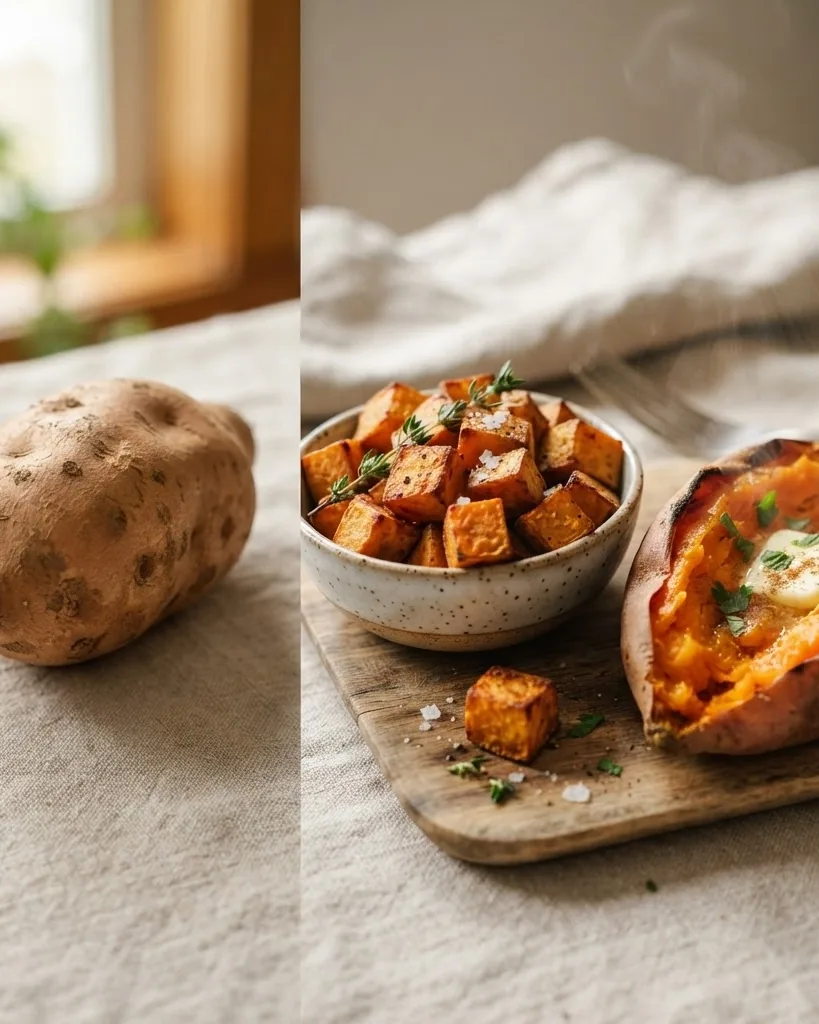
These two are not interchangeable, and the difference is botanical. White potatoes belong to the nightshade family, Solanaceae, which means they can produce glycoalkaloids, natural compounds that are mildly toxic and concentrate in green or raw potato. Sweet potato is not a nightshade at all, a point sourced to Hemopet, so it does not make those glycoalkaloids. That is a genuine safety edge for the orange root when both are served cooked and plain. It does not make white potato dangerous in small cooked amounts, but it does mean raw or green white potato deserves more caution than sweet potato. For a treat you feed occasionally, the sweet potato’s higher beta-carotene and nightshade-free profile make it the tidier choice.
Warning Signs and When to Call Your Vet
Most sweet potato problems are small and self-limiting, but a few deserve a call. Because the root is starchy and fibrous, too much too fast tends to cause gas, soft stool, or an upset stomach that clears on its own. In a small dog that ate a raw chunk, watch for choking, gagging, or repeated unproductive retching, all of which point to a possible obstruction and warrant an urgent call.
Trust the timeline. A single loose stool the evening after a new treat is common.
Keep a short mental checklist for the vet call:
- Symptoms lasting longer than 24 hours.
- Lethargy, hiding, or unusual dullness.
- Repeated vomiting, or any suspected choking.
- Known diabetes, urinary stones, or heart disease plus a new reaction.
For general canine symptom guidance you can cross-check the Merck Veterinary Manual, though a reference is never a substitute for your own vet who knows the dog. When something looks wrong and you cannot reach the clinic, an emergency line is the right next step.
Frequently Asked Questions
Can dogs eat sweet potato fries?
No, homemade or takeout fries are a poor choice. Frying loads the flesh with fat and usually salt, and restaurant fries often carry seasonings like garlic or onion powder that are toxic to dogs. If you want to share, offer plain baked, steamed, or boiled sweet potato instead, cut small and served without oil, salt, or coatings.
Can dogs eat raw sweet potato?
No, raw sweet potato is off limits. It is dense, starchy, hard to chew, and difficult to digest, and a firm chunk can cause choking or an intestinal obstruction, especially in smaller dogs. Cooking softens the starch so the gut can handle it. Always steam, boil, or bake until fork-tender, then cool and cut it into small pieces before feeding.
Can dogs eat sweet potato every day?
Better not to make it a daily habit. Sweet potato should stay within the 10 percent treat limit, meaning treats cover no more than 10 percent of daily calories while a complete food supplies the rest. At roughly 90 kcal per 100 grams, small servings add up. Rotate it as an occasional extra rather than a fixed part of every meal.
Should I peel sweet potato for my dog?
Peeling is the safer default, particularly for small dogs, puppies, seniors, and dogs with sensitive stomachs. The skin adds fiber but is tougher to digest and can cause gas or loose stool. A healthy large dog can usually handle thin, well-cooked skin, but when introducing sweet potato for the first time, peel it and start with a tiny portion.
Are canned sweet potatoes safe for dogs?
Usually no, not the sweetened kind. Canned sweet potato is often packed in syrup or spiced for pie, and added sugar, salt, and spices are exactly what dogs should avoid. If a can is plain sweet potato with nothing added, it can work in small amounts, but plain fresh flesh you cooked yourself is the cleaner, more reliable option.
Can puppies eat sweet potato?
In tiny amounts and with care. Puppies have specific growth needs and a small margin for rich treats, so sweet potato should never crowd out balanced puppy food. Serve a small piece of plain, peeled, well-cooked flesh, watch for any digestive upset, and ask your veterinarian before making it a regular treat, especially for young or sensitive pups.
The Bottom Line on Sweet Potatoes for Dogs
Cooked, plain, peeled, and portioned, sweet potato is a solid occasional treat for a healthy dog, rich in beta-carotene, fiber, and potassium, and free of the nightshade glycoalkaloids that white potato can carry. Keep raw off the menu, keep servings inside the 10 percent limit, and hold back entirely for diabetic dogs, stone-formers, and overweight dogs until your vet signs off. The FDA heart investigation is a reason to think about main-diet ingredients, not to fear a spoonful of mash. And if your search for safe extras is really about managing a sore or aging dog, read our guide to safe pain relief options for dogs before reaching for anything in the cabinet.