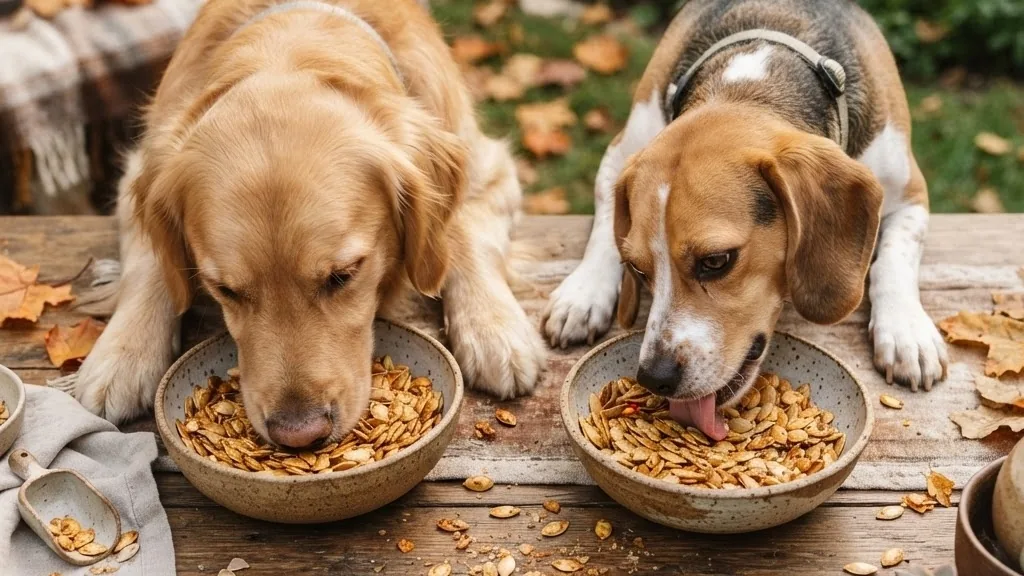
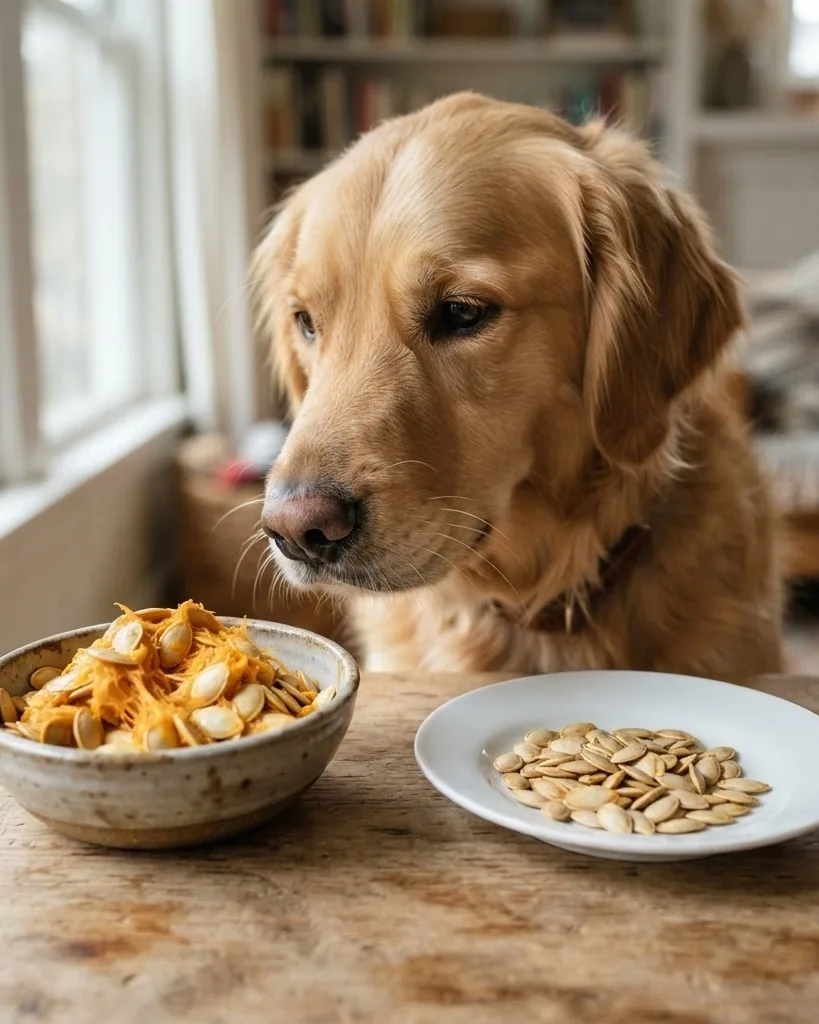
Can dogs eat pumpkin seeds without harm? Yes, plain hulled pumpkin seeds are non-toxic to dogs in small amounts, and the American Society for the Prevention of Cruelty to Animals lists Cucurbita pepo as non-toxic to dogs, cats, and horses. That is the short verdict. The longer, more useful truth is that the seeds are not nutritionally necessary, salted or seasoned ones are a genuine problem, and the popular deworming claim rests on studies that were never run in dogs. What follows is the arithmetic, the thresholds, and the triage none of the top-ranking pages currently give you.
The gap between “not poisonous” and “worth feeding” is where most owners get tripped up. A kernel is essentially a fat pellet. At 559 kcal per 100 g, a handful of pepitas carries more calorie punch than most people assume, and that single fact reshapes every serving decision. Before you portion anything, it helps to read our guide on whether sweet potatoes are good for dogs, because the same treat-ceiling logic applies to any human food you add to a bowl.
Quick answer: Yes, dogs can eat plain hulled pumpkin seeds in small amounts. They are non-toxic per the ASPCA, but they are dense, roughly 49 percent fat by weight, so they belong inside the 10-percent treat allowance, not on top of it. Skip salted, roasted-in-oil, or spiced pepitas, and skip whole in-shell seeds for small breeds and puppies because of choking and obstruction risk. Grind the kernels if you want any nutritional benefit, keep the count low, and introduce them one food at a time so any reaction is traceable.
Toxic Versus Safe-But-Inadvisable: The Distinction Every Page Blurs
Pumpkin seeds are not on any veterinary toxic-plant list. The ASPCA Animal Poison Control Center classifies acorn squash and its relatives, including pumpkin, as non-toxic to dogs, and its scientific entry names Cucurbita pepo in the family Cucurbitaceae. So the real hazards here are not poisoning. They are dose, fat, sodium, calories, and mechanical obstruction. That reframing matters because it changes what you watch for and who you call. You are not managing a toxin; you are managing a rich, oily food that a dog’s gut handles poorly in quantity.
Think of it the way you would a bowl of nuts left on a coffee table. One or two do nothing. A whole bag causes a very unpleasant night. The danger scales with amount, not with a single dangerous molecule.
Salted commercial pepitas add a second axis of risk. Per the Merck Veterinary Manual, clinical salt toxicosis in dogs typically requires ingestion around 2 to 3 g of sodium chloride per kilogram of body weight, with an acute oral lethal dose near 4 g/kg. Those are large numbers. A 5 kg dog would need roughly 10 g of pure salt to reach the low end of that range, which no reasonable serving of pepitas contains. Salted seeds are a gastrointestinal upset and sodium-load problem long before they are ever a poisoning problem, and pretending otherwise misleads owners.
Nutrition: Why a Kernel Is Basically a Fat Pellet
The reason pumpkin seeds get sold as a canine superfood is human nutrition marketing, and it does not transfer cleanly. According to USDA FoodData Central entry 170556, dried hulled pumpkin and squash seed kernels deliver 559 kcal per 100 g, 49.05 g of fat, and 30.2 g of protein. Roasted without salt, entry 170557 puts them slightly higher at 574 kcal per 100 g. Fat supplies roughly 79 percent of the calories. That is the number that quietly dismantles the “low-calorie weight-management snack” pitch you will see elsewhere.
The mineral profile is genuinely impressive on paper. Per 100 g of dried kernels, USDA lists magnesium at 592 mg, phosphorus at 1233 mg, potassium at 809 mg, iron at 8.82 mg, and zinc at 7.81 mg.
Here is the catch a healthy dog does not need supplementation. A diet carrying the “complete and balanced” statement defined by the Association of American Feed Control Officials already supplies these minerals at the levels the National Research Council’s Nutrient Requirements of Dogs and Cats established. You are not filling a gap. You are adding calories the diet already accounts for.
Two USDA facts deserve special attention:
- Phosphorus at 1233 mg per 100 g. For a dog on a phosphorus-restricted renal diet, that is a reason to skip seeds entirely, and no popular page flags it.
- Sodium jumps about 36-fold with salting. Unsalted dried kernels carry 7 mg sodium per 100 g; salted roasted kernels carry 256 mg. The salting step, not the seed, is the sodium story.
If your dog is on a sodium-limited plan, that difference is decisive, and our breakdown of low sodium dog food and the numbers vets actually use explains why a single salty treat can undo a careful therapeutic diet.
How Many Pumpkin Seeds Can a Dog Actually Eat?
This is the question the query is really asking, and it is answerable with a formula rather than a shrug. Veterinary nutrition consensus, echoed by the American Kennel Club and the World Small Animal Veterinary Association Global Nutrition Committee, holds that treats and extras should stay under 10 percent of daily calories, with the other 90 percent coming from a complete and balanced diet. That 10 percent is a heuristic, not a regulated limit, but it is the right anchor. Combine it with a resting energy estimate and you get a real ceiling instead of a vague “a few.”
The math uses two standard equations. Resting energy requirement, RER, equals 70 times body weight in kilograms raised to the 0.75 power. Maintenance energy requirement, MER, for a neutered adult is roughly 1.6 times RER, though that multiplier ranges from about 1.2 to 1.8 with age, neuter status, and activity.
Worked example for a 10 kg dog, shown so you can rerun it for your own animal:
- RER is about 393 kcal (70 times 10 to the 0.75 power).
- MER is about 630 kcal per day (1.6 times 393).
- Ten percent of 630 is 63 kcal, the absolute daily treat allowance.
- Kernels run about 1.1 kcal each, so 63 kcal is roughly 55 kernels or about 11 g. That is the ceiling if seeds were the only treat that day.
That ceiling is a hard maximum, not a target. In practice, feed an order of magnitude below it. The AKC’s own guidance stresses that the 10 percent covers everything the dog eats beyond its meals, so a training session of biscuits plus a scatter of pepitas fills that budget fast.
Portion sanity by body-weight band, using ground kernels and staying well under the ceiling:
- Toy breeds: whole seeds are a choking risk, so grind before offering anything, and scale the treat math above accordingly.
- 5 kg (about 11 lb): a few ground kernels, no more.
- This is the same weight used in the worked example above, so use that calculation as your reference point.
- Scale the treat math above to your dog’s own MER, and keep pumpkin seeds a small share of that budget.
There is also a published-number mess worth correcting. Some pet-health pages claim 75 calories per tablespoon and others claim 75 calories per teaspoon for pumpkin seeds. Both cannot be true. Using USDA density, a tablespoon of kernels weighs roughly 8 to 10 g, which is about 45 to 56 kcal, and a teaspoon at roughly 3 g is about 17 kcal. The per-teaspoon figure is simply wrong. When a source gives you a calorie count, check which spoon and which form, hulled or in-shell, it means.
Whatever number you land on, introduce slowly, feeding only one new food at a time. That way, if loose stool shows up, you know exactly what caused it.
Why Dogs Get Less Out of Seeds Than People Do
Whole pumpkin seeds pass through a dog largely intact, which means most of the advertised minerals never get absorbed. A canine gastrointestinal tract is not built to grind down tough seed matter the way it processes meat and rendered fat. If you want any of that magnesium or zinc to actually reach the bloodstream, the kernel has to be ground first. Feeding whole seeds and expecting a nutritional payoff is like swallowing multivitamins still sealed in their bottle.
Grinding also removes the mechanical hazard. A ground kernel cannot lodge in a small dog’s throat or wedge in the gut the way an in-shell seed can.
Grinding introduces a storage catch, though. These kernels are roughly half fat, and once you break the seed coat and expose that oil, rancidity sets in quickly. Grind small batches, refrigerate what you do not use immediately, and discard anything that smells sharp or paint-like. Rancid fat is its own gastrointestinal insult and defeats the point of feeding a “healthy” seed in the first place.
The Deworming Claim, Graded Honestly With Primary Sources
The single most repeated myth about pumpkin seeds is that they deworm dogs, and the honest answer is that no controlled canine trial has ever been published to support it. The active compound people cite is cucurbitin, an amino acid in the seed. The evidence for it is real but narrow, and reading the actual studies rather than the blog summaries changes the conclusion. Here is the full chain, graded rather than asserted, so you can see exactly how thin the ground is under the popular claim.
The most-cited primary work is Diaz Obregon and colleagues, published in 2004 and indexed on PubMed as 15614300. Investigators found that a minimum inhibitory concentration of 23 g of pumpkin seed in 100 mL of distilled water, described as equivalent to about 73 seeds, produced an anthelmintic effect against canine tapeworms. Mean parasite survival was 38.4 minutes, with visible destruction of the worm’s outer layer under the microscope. Crucially, this was an in vitro isolation study. It measured what a seed slurry does to worms in a dish, not what happens when a dog eats seeds.
The second study is Grzybek and colleagues, published in the International Journal of Molecular Sciences in 2016, doi 10.3390/ijms17091456. All C. pepo seed extracts showed nematicidal activity in vitro against Caenorhabditis elegans and Heligmosomoides bakeri larvae, with the ethanol extract strongest, and the in vivo confirmation came in mice. Again, note the words: extracts, not whole seeds, and mice, not dogs.
Put together, the picture is clear. There is in vitro tapeworm data and rodent in vivo data using concentrated extracts, and there is no randomized controlled trial of whole pumpkin seeds as a dewormer in dogs.
Chewy’s veterinary contributor makes an honest mechanistic point worth repeating: if a dog eats enough seeds to pass worms, it is usually because the fat and fiber load caused diarrhea that flushed them, not because the seed killed anything. For actual parasite control, the Companion Animal Parasite Council in the United States and its European counterpart ESCCAP both point to prescribed anthelmintics, not kitchen remedies. If you suspect worms, a fecal test and a proper dewormer from your veterinarian are the answer.
Preparation: The Only Safe Way to Serve Them
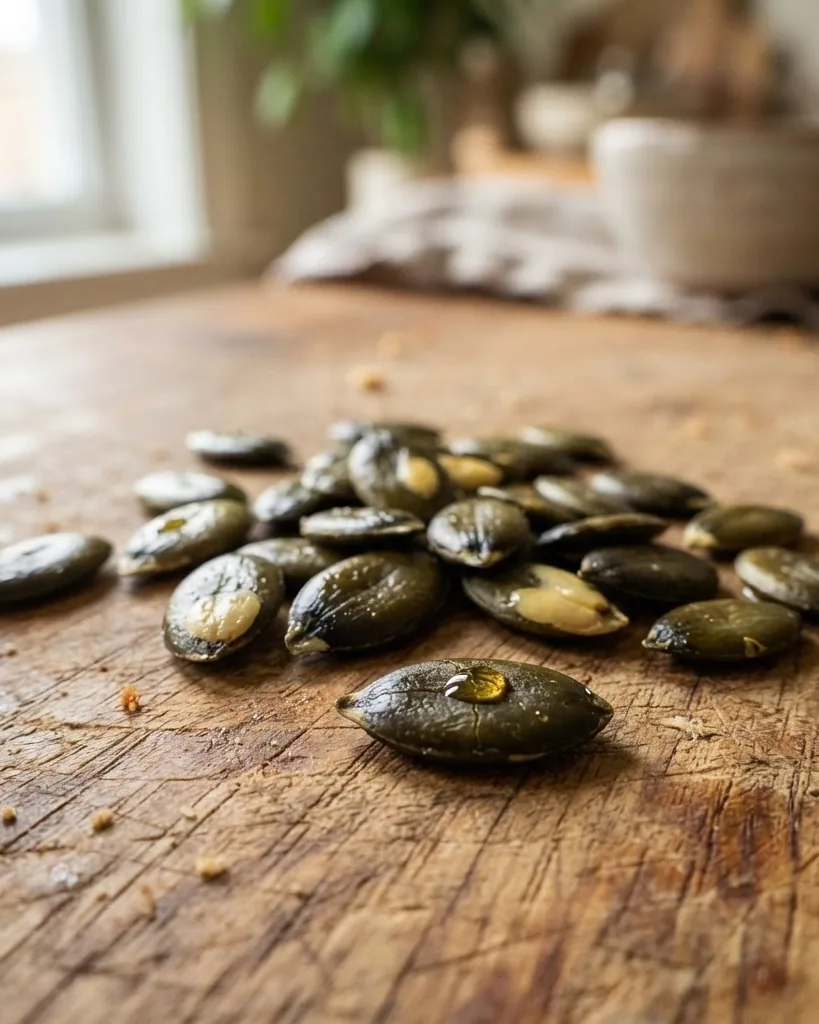
Preparation is where a harmless snack turns into a vet visit, so the protocol matters. The safe version is short: dehull the seeds, rinse them, either serve raw or dry-roast them plain, grind the kernels, and refrigerate what you do not use. Everything dangerous lives in the additions people make for their own taste. No oil, no salt, no garlic or onion powder, no pumpkin-pie spice, and absolutely nothing sweetened with xylitol, which is severely toxic to dogs even in tiny amounts. Plain and ground is the whole recipe.
The seasonings are not garnish-level concerns. Garlic and onion powders belong to the allium group and damage canine red blood cells. A single step, quick and dull:
- Buy plain, unsalted, unseasoned seeds, or scoop them from a fresh pumpkin.
- Remove the fibrous pulp, rinse, and pat dry.
- Dry-roast in a plain pan or oven with no oil, or leave raw.
- Grind to a coarse meal and store cold in a sealed jar.
Skip anything from a bag labeled roasted and salted, honey-roasted, or spiced. Those are formulated for human palates, and the sodium alone pushes a treat that should be trivial into territory you would rather avoid, especially for a small dog.
Risks Ranked by How Often They Actually Happen
The real-world hazards of pumpkin seeds are predictable, and ranking them by frequency helps you worry about the right things. The most common problem by far is simple gastrointestinal upset: the combined fat and fiber load triggers vomiting or diarrhea, usually when a dog eats far more than a pinch. Second is slow calorie creep, where daily seeds displace balanced nutrition and add weight over weeks. Third, and more serious, is pancreatitis in predisposed dogs, because at 49.05 g of fat per 100 g these kernels are a meaningful fat challenge to a sensitive pancreas.
The remaining risks are situational but real:
- Sodium load from salted commercial pepitas, at 256 mg per 100 g versus 7 mg unsalted.
- Choking or obstruction from whole in-shell seeds, particularly in small breeds and puppies.
- Allium and xylitol contamination hiding in flavored or sweetened products.
A change in thirst or appetite after a fatty snack is not something to shrug off. If your dog suddenly seems parched, our triage guide on why a dog may be drinking so much water walks through what is benign and what warrants a call. Sugar-free products are the sharpest edge here; the same xylitol warning we cover in our piece on whether dogs can eat marshmallows applies directly to any sweetened seed snack.
Dogs That Should Get Zero Seeds
Some dogs should never be offered pumpkin seeds at all, and the reasons trace straight back to the USDA numbers rather than caution for its own sake. Any dog with a history of pancreatitis is on the list, because 49 percent fat by weight is exactly the kind of load that provokes a flare. Dogs with hyperlipidemia, including breeds predisposed to it such as the Miniature Schnauzer, fall in the same category. So does any dog that is obese or on an active weight-loss plan, since spare treat calories directly oppose the goal.
Medical diets add more exclusions:
- Phosphorus-restricted renal diets: 1233 mg phosphorus per 100 g is disqualifying.
- Sodium-restricted diets: salted pepitas at 256 mg per 100 g work against the therapy.
- Therapeutic or elimination diets: any add-on breaks the diagnostic value of the trial.
- Puppies and small breeds: obstruction and choking risk from whole seeds.
For diet formulation in a dog with any of these conditions, the right referral is a veterinarian, ideally one boarded by the American College of Veterinary Nutrition, not a blog. When in doubt, leave the seeds out; nothing in them is essential.
My Dog Ate a Whole Bag: Triage
If your dog raids a bag of pumpkin seeds, stay calm and reason from the numbers rather than panic. For plain, unsalted kernels the likely outcome is gastrointestinal, so watch for vomiting, repeated diarrhea, lethargy, abdominal pain, or refusal to eat. Those signal the fat load hitting a sensitive gut or, in a predisposed dog, an emerging pancreatitis. For salted seeds, add tremors or unsteady gait to the watch list, since those point to sodium excess, and make sure fresh water is always available.
Use the salt threshold to triage rationally instead of fearfully. A dog needs roughly 2 to 3 g of sodium chloride per kilogram before clinical toxicosis appears, so a spilled snack bag rarely reaches that line, but a large dog eating a family-size bag of salted pepitas is worth a call.
Keep two numbers on the fridge. The ASPCA Animal Poison Control Center is reachable 24/7 at 888-426-4435, and Pet Poison Helpline at 855-764-7661; both may charge a consultation fee. When you call, have the product label, an estimate of how much was eaten, and your dog’s weight ready. If you see tremors, collapse, or nonstop vomiting, skip the hotline and go straight to an emergency clinic. This is a sensitive area, and none of the above replaces a hands-on exam from your own veterinarian.
The Other Parts of the Pumpkin
The seed is the least useful part of the pumpkin for a dog, which is the twist most benefit lists get backwards. Plain cooked pumpkin puree, not pie filling, is the part with real value: it is high in water and fiber and low in calories, which makes it genuinely helpful for mild digestive upset. That is the opposite of the kernel, which is calorie-dense and fatty. Confusing the two is how a fatty seed ends up marketed as a weight-management food, and the USDA figures make that framing untenable.
Steer clear of the decorative and processed forms:
- Pumpkin-pie filling: loaded with sugar and spices, sometimes xylitol.
- Rind, stem, and leaves: tough and hard to digest.
- Jack-o’-lanterns left outdoors: mold risk once they start to rot.
Pumpkin seed oil and seed-based supplements are a separate product with a separate evidence base, most of it drawn from human urology research that does not transfer to dogs. Treat them as unproven for canine use rather than assuming the seed’s reputation carries over.
Frequently Asked Questions
Can puppies eat pumpkin seeds?
It is best to skip them for puppies. Whole seeds pose a choking and obstruction risk in small mouths, and a growing dog’s calorie budget is better spent on a complete and balanced diet built for development. If you want to offer a taste, use a tiny amount of ground plain kernels, introduce one food at a time, and check with your veterinarian first, since puppies tolerate dietary experiments poorly.
Raw or roasted pumpkin seeds, which is safer?
Both are acceptable if plain, with a trade-off. USDA puts dried kernels at 559 kcal per 100 g and roasted-unsalted at 574 kcal per 100 g, so the calorie difference is small. Raw high-oil kernels turn rancid faster once ground, while plain dry-roasting extends shelf life. Whichever you choose, no oil, no salt, and no seasoning, and grind the kernels for any real benefit.
Do pumpkin seeds get rid of worms in dogs?
No controlled canine trial supports this. Any worms passed after eating seeds usually leave because the fat and fiber caused diarrhea. For real parasite control, use a prescribed dewormer guided by the Companion Animal Parasite Council or ESCCAP.
How many pumpkin seeds can a small dog eat?
Very few, and many small dogs are better off skipping them. Kernels run about 1.1 kcal each, and a toy breed’s entire treat allowance is tiny under the 10-percent rule the American Kennel Club recommends. If you offer any, use a pinch of ground plain kernels, never whole in-shell seeds, and count them against every other treat the dog gets that day.
Are salted pumpkin seeds safe for dogs?
Salted pepitas are best avoided. Salting raises sodium from 7 mg to 256 mg per 100 g, roughly a 36-fold jump, per USDA data. That is not usually a poisoning risk, since the Merck Veterinary Manual puts salt toxicosis near 2 to 3 g per kilogram, but it is a real problem for dogs on sodium-restricted diets and a needless gastrointestinal irritant for any dog.
Should I grind pumpkin seeds before feeding?
Yes, if you want any nutritional benefit. Whole seeds pass through a dog largely intact because the canine gut cannot break down the tough seed coat, so the advertised magnesium, phosphorus, and zinc never get absorbed. Grinding also removes the choking hazard. Grind small batches, refrigerate promptly, and discard anything that smells sharp, since the exposed oil goes rancid fast.