
Low sodium dog food is one of the most misunderstood categories in the pet aisle, and the confusion starts with a single wrong assumption: that less salt is always better. It is not. Restricting sodium hard in a healthy dog, or in a dog with an early murmur and no clinical signs, does nothing useful and can backfire by making the bowl so bland the dog stops eating. The right question is never “is this food low in sodium,” it is “does this specific dog, at this specific disease stage, actually need sodium restriction, and how much.”
That distinction is medical, not marketing. Sodium runs fluid balance, blood pressure, and nerve and muscle signaling, so a diet has to hit a physiological floor before “lower” becomes “harmful.” Below you will find the exact thresholds cardiologists use, the AAFCO minimums a food cannot dip under, and the hidden salt sources that quietly wreck an otherwise careful plan. Managing a dog with cardiac or kidney issues requires shifting your focus from marketing claims on the front of the bag to the precise nutritional analysis required for specific clinical conditions.
Quick answer: what low sodium dog food is and who needs it
Low sodium dog food is a diet built to keep sodium at or below roughly 100 mg per 100 kcal, and in most restricted cases at or below 80 mg per 100 kcal, compared with about 100 mg per 100 kcal in a typical maintenance food. It is indicated for dogs with congestive heart failure, chronic kidney disease, or hypertension, prescribed and staged by a veterinarian. A healthy dog does not need it.
Severe restriction is reserved for heart failure, not for an early murmur, because over-restriction can trigger appetite loss and dangerous muscle wasting. Treating the condition without the right staging leads to wasted effort or worse, potential health complications. Always confirm the specific sodium requirement with a veterinarian who has access to your dog’s complete medical history and blood panel results.
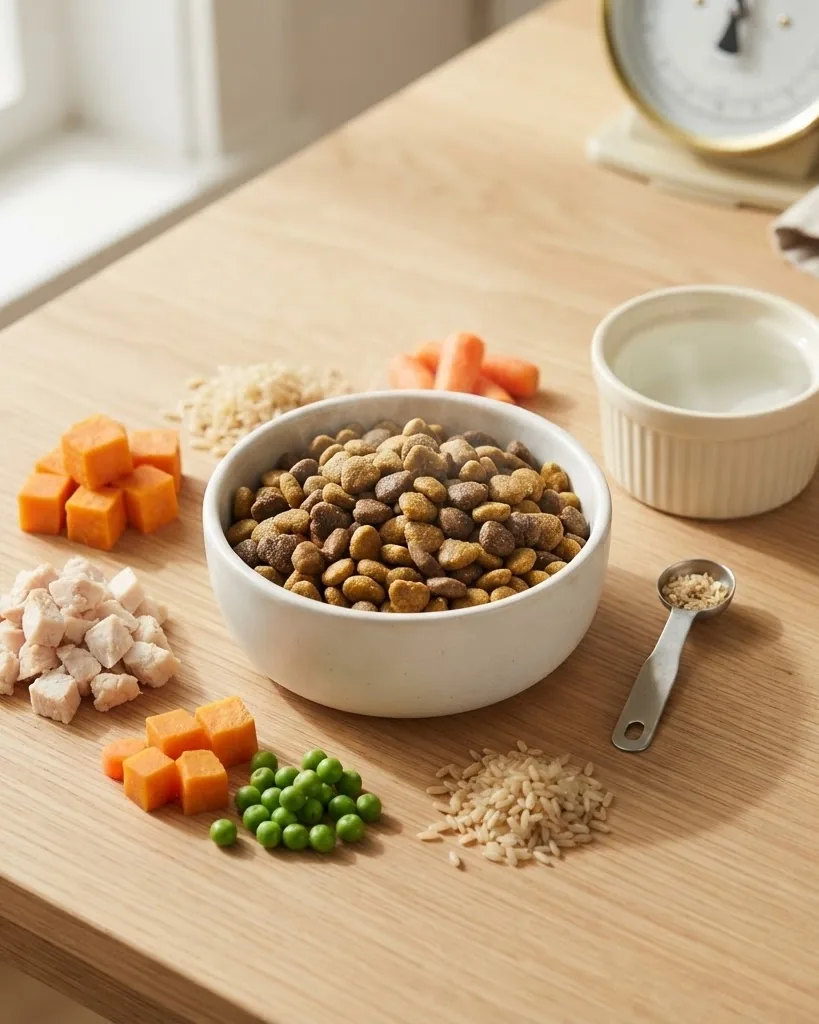
What sodium does, and why the floor matters as much as the ceiling
Sodium is an essential mineral, not a contaminant to be scrubbed out. It governs the movement of water between compartments in the body, supports blood pressure, and lets nerves fire and muscles contract. Pull it too low and a dog can suffer real harm, which is why every credible diet is built around a floor as well as a ceiling. The Association of American Feed Control Officials sets the adult maintenance minimum at 0.08 percent sodium on a dry matter basis, rising to 0.3 percent dry matter for growth and reproduction.
Chloride minimums sit at 0.12 percent for adults and 0.45 percent for growth, with a target sodium-to-chloride ratio near 1 to 1.5. These constraints prevent electrolyte imbalances that can occur if one mineral is restricted without regard for the other. When a company formulates a diet, they must balance these minerals to maintain cellular integrity and proper hydration levels in the pet.
Those are the numbers the Merck Veterinary Manual and the National Research Council anchor their guidance to. A standard commercial food usually lands around 0.5 percent sodium dry matter, inside a 0.3 to 1.0 percent range, which works out to roughly 1.0 gram of sodium per 1,000 kcal, or about 100 mg per 100 kcal.
- Adult maintenance sodium minimum: 0.08 percent dry matter.
- Growth and reproduction minimum: 0.3 percent dry matter.
- Typical maintenance food: about 0.5 percent dry matter, roughly 100 mg per 100 kcal.
The takeaway is simple. A food that undercuts the physiological need is not “healthier,” it is deficient. You can review the mineral requirements yourself on the Merck Veterinary Manual small animal nutrition page.
The mg per 100 kcal thresholds cardiologists actually use
Cardiologists do not talk in percentages on the bag. They talk in milligrams of sodium per 100 kcal, because that unit tracks what the dog actually eats relative to energy. Percent dry matter on a label ignores calorie density, so two foods with the same percentage can deliver very different sodium loads per meal. The Clinical Nutrition Service at Tufts Cummings School defines a reduced-sodium diet as one at or below 100 mg per 100 kcal, and in most cases at or below 80 mg per 100 kcal, and it maintains a list of more than 40 reduced-sodium foods across dry and canned formats.
From there, restriction is graded by disease stage rather than applied as one flat rule:
- Mild restriction, 80 to 100 mg per 100 kcal: early-stage heart or kidney disease and mild hypertension.
- Moderate restriction, 50 to 80 mg per 100 kcal: more advanced disease.
- Severe restriction, under 50 mg per 100 kcal: congestive heart failure, under veterinary supervision only.
To convert a label, remember that a typical food near 0.5 percent dry matter equals roughly 100 mg per 100 kcal, so a “mild” target of 80 to 100 mg per 100 kcal is only a modest step down, while under 50 mg per 100 kcal is a genuine clinical diet. Because manufacturers are not required to print sodium content, you often have to call the company and ask for the mg per 100 kcal figure directly.
Do not rely on the front-of-package marketing terms. Request the full nutrient analysis from the manufacturer, specifically asking for the sodium density per 100 kilocalories. Tufts explains the same math for owners in its guide, Are you sodium savvy?, from the Cummings School Petfoodology team.
When restriction is indicated, and the early-stage trap
Sodium restriction earns its place in three conditions: congestive heart failure, chronic kidney disease, and hypertension. It is not a wellness upgrade for a healthy dog. Heart disease affects roughly 10 to 15 percent of dogs and cats overall, with far higher rates in predisposed breeds, and about 10 percent of dogs eventually develop cardiac disease severe enough to warrant sodium restriction. Another 10 percent or so develop chronic kidney disease, which also calls for restriction. The trap most owners and even some product pages fall into is treating “low sodium” as universally protective.
Here is the consensus that gets skipped. Slapping severe restriction on a dog the moment a murmur is heard, before any clinical signs appear, is not helpful. The American College of Veterinary Internal Medicine stages myxomatous mitral valve disease as A, B, C, and D, and mild dietary changes may help in earlier stages while additional restriction is justified only once congestive heart failure develops.
Push a bland, hard-restricted diet too early and you risk the dog refusing food, which leads to calorie deficits and muscle mass loss. If your dog is eating well, do not disrupt that balance unnecessarily without clear diagnostic evidence that the heart or kidneys are struggling to process standard sodium levels. Work with your veterinary cardiologist to establish the correct staging before making permanent dietary changes.
The staging framework is laid out in the peer-reviewed ACVIM consensus guidelines for MMVD in dogs. If your dog is drinking or urinating more than usual, that can point to kidney involvement worth investigating; our guide to excessive thirst and the owner triage process walks through when that symptom matters.
Heart versus kidney: the diets are not interchangeable
A cardiac diet and a renal diet both cut sodium, but a renal diet does more. Kidney formulas add restricted phosphorus and reduced protein on top of lower sodium. A typical renal diet runs around 0.10 to 0.25 percent sodium dry matter, phosphorus near 0.28 to 0.61 percent dry matter, and protein pulled down deliberately. A heart diet, by contrast, protects protein quality to fight muscle loss.
Feeding a renal food to a cardiac dog, or the reverse, can undermine the very goal you are chasing, which is why the target disease has to be named before the food is chosen. Protein is crucial for cardiac patients to maintain cardiac muscle mass; depriving them of protein because of a renal-focused formula can accelerate cachexia. Always match the dietary intervention to the primary diagnosed condition, not just the “low sodium” label.
Permits, labels, and the compliance rules behind the bag
The claim on the front of the bag is governed, but loosely, and understanding who regulates what saves you from buying the wrong product. The Association of American Feed Control Officials writes the model nutrient profiles that define “complete and balanced,” setting the minimums and maximums a maintenance food must meet. The National Research Council supplies the underlying science in its Nutrient Requirements of Dogs and Cats, published in 2006, which is the physiological baseline AAFCO profiles lean on.
Neither body inspects your specific bag, and neither requires sodium content to be printed, which is the single biggest gap owners run into. Labeling itself falls to the Food and Drug Administration Center for Veterinary Medicine, which regulates pet food claims in the United States and also ran the high-profile investigation into a possible link between grain-free diets and dilated cardiomyopathy. That distinction between “complete and balanced” and “intermittent and supplemental feeding only” is where money and safety collide.
Some products labeled “restricted sodium” do not meet AAFCO adult maintenance requirements and carry an “intermittent and supplemental feeding only” statement, meaning they are a topper, not a full meal replacement. If you feed these as a total diet, you will inevitably create nutrient gaps that are dangerous for a dog with an underlying illness.
What does compliance cost the owner in practice? Several layers:
- A prescription veterinary diet requires a paid consultation and often diagnostic imaging or bloodwork before it can be authorized.
- A phone call to the manufacturer is frequently the only way to get the sodium figure in mg per 100 kcal, since printing it is not mandatory.
- Feeding an “intermittent and supplemental” product as a main meal risks a nutrient shortfall the label already warned you about.
For a plain-language read on food safety and toxic ingredients, the ASPCA maintains a widely cited list, People Foods to Avoid Feeding Your Pets, and the American Kennel Club published a clear owner explainer of the DCM question at its FDA grain-free diet alert. The FDA’s own case tracking lives on the FDA investigation into diet and canine dilated cardiomyopathy page.
The grain-free and DCM myth, kept in proportion
Grain-free diets became shorthand for danger during the DCM scare, but the picture is messier than the headlines. The Center for Veterinary Medicine received reports of non-hereditary dilated cardiomyopathy tied to both grain-free and grain-containing diets, so “grain-free equals heart disease” is not an accurate summary. If your dog already has a cardiac diagnosis, the diet decision belongs with your veterinarian, not with a marketing category. Do not switch to or away from grain-free on your own as a heart treatment.
The rest of the bowl: hidden sodium and the calorie problem
The food is only part of the equation, and this is where most careful plans quietly fall apart. A restricted diet in the bowl means little if the dog is getting cured meat, salty table scraps, or high-sodium chews on the side. Just as important, the number one nutritional problem in canine heart disease is not sodium at all, it is calories. Cardiac cachexia, the loss of lean muscle mass, harms strength, immune function, and survival, which is why a diet so bland the dog eats less can be more dangerous than a slightly higher sodium level. Palatability is a clinical concern, not a luxury.
Treats should stay at or below 10 percent of daily calories, and they need to be low-sodium themselves to count. The usual hidden culprits go far beyond the pantry:
- Table scraps, deli and cured meats, and broth, all typically salt-heavy.
- Rawhide, bully sticks, and dental chews, which can carry meaningful sodium.
- Supplements and even some pet toothpaste formulations.
Fresh, frozen, or dehydrated foods often run lower because salt is a common preservative in shelf-stable products, so removing the preservative can lower the load. Even so, “lower” still has to clear the AAFCO floor to qualify as a real meal. When you audit chews, apply the same scrutiny you would to a topper; our breakdown of dehydrated chicken feet as a chew shows how to weigh a single-ingredient treat against a dog’s daily budget.
Nutrients that protect the cardiac patient
A good heart diet adds, it does not only subtract. Beyond controlled sodium, cardiologists look for high-quality protein to counter cachexia, omega-3 fatty acids in the form of EPA and DHA, plus taurine and L-carnitine, which support cardiac muscle. This is the substance behind why a prescription cardiac diet is not simply “the same kibble with less salt.”
If you are tempted to build a homemade low-sodium diet, do it only with a board-certified veterinary nutritionist. An improvised recipe almost always misses one of these targets, and the deficiency can outweigh any sodium benefit. A board-certified nutritionist can provide a recipe that accounts for all essential nutrients, including trace minerals, to ensure your dog is not just getting less salt, but also getting the complete nutrition required to manage the disease process over the long term.
How to transition, and the red flags that mean call now
Switching foods too fast invites vomiting and diarrhea, and a dog that associates a new bowl with feeling sick becomes far harder to feed, which is the last thing a cardiac or renal patient needs. Move over roughly a week, blending increasing amounts of the new diet into the old, and watch appetite closely since palatability drives success in restricted feeding. If the dog is skipping meals, that is a signal to slow the transition or revisit the plan with your veterinarian rather than to push through.
Some symptoms are not “monitor at home” material. Certain signs point to worsening heart or kidney disease and warrant same-day veterinary attention:
- Labored or fast breathing, or breathing distress at rest.
- A new or worsening cough, especially at night.
- Swelling of the abdomen or limbs, suggesting fluid retention.
Pair the diet with vigilance on everything else that touches the dog’s system. Owners managing a cardiac or renal patient should confirm any medication is appropriate, since some over-the-counter options are risky; our guide to safe versus toxic pain relief options for dogs covers what to avoid, and if you are weighing produce as a low-sodium treat, the numbers in our piece on whether sweet potatoes suit dogs help you keep additions inside that 10 percent calorie rule.
Frequently asked questions about low sodium dog food
Is low sodium dog food good for all dogs?
No. Sodium restriction is a medical intervention for dogs with congestive heart failure, chronic kidney disease, or hypertension, not a wellness choice for healthy dogs. Restricting a healthy dog can make food bland enough to reduce intake, which risks weight and muscle loss over time.
What sodium level counts as low sodium for dogs?
Cardiologists measure sodium in mg per 100 kcal rather than percentages. The Tufts Cummings School threshold for a reduced-sodium diet is at or below 100 mg per 100 kcal, and in most cases at or below 80 mg per 100 kcal.
Should I put my dog on a low sodium diet after hearing a heart murmur?
Not automatically. The American College of Veterinary Internal Medicine stages heart disease A through D, and severe restriction before clinical signs appear is unnecessary. Mild dietary changes may help earlier, but additional restriction is justified only once congestive heart failure develops. Ask your veterinarian which stage your dog is in before changing the diet, since over-restriction can hurt appetite.
Do low sodium diets replace a normal meal?
Only if they are labeled complete and balanced. Some products marked restricted sodium carry an intermittent and supplemental feeding only statement, meaning they do not meet AAFCO adult maintenance requirements and function as a topper, not a meal. Check the nutritional adequacy statement on the bag, and call the manufacturer for the sodium figure in mg per 100 kcal since printing it is not mandatory.
Are treats and chews a problem on a low sodium plan?
They can be the weak point. Rawhide, bully sticks, dental chews, cured meats, and table scraps all add hidden sodium that undoes a careful bowl. Keep all treats at or below 10 percent of daily calories and choose low-sodium options. Fresh, frozen, or dehydrated foods often run lower because salt is a common preservative, but any product still has to meet the dog’s physiological floor.
Can I make low sodium dog food at home?
Only with a board-certified veterinary nutritionist. Homemade cardiac diets need controlled sodium plus high-quality protein to fight muscle wasting, omega-3 fatty acids as EPA and DHA, taurine, and L-carnitine. Improvised recipes usually miss one of these, and the resulting deficiency can outweigh any sodium benefit. A nutritionist can balance the recipe to your dog’s stage and keep calories high enough to prevent cardiac cachexia.
What is cardiac cachexia?
Cardiac cachexia is the involuntary loss of lean body mass, such as muscle, in dogs with heart disease. Even if the dog maintains a steady weight, they may be losing vital muscle tissue, which impacts their strength and immune response. This often happens because of decreased appetite due to heart medication or a bland low-sodium diet that the dog does not enjoy eating. Keeping the diet palatable is essential for survival.
Why does kidney disease require low sodium?
In chronic kidney disease, the kidneys have a diminished ability to regulate electrolyte levels in the blood, including sodium. Excess sodium intake can increase blood pressure, which further stresses the already compromised kidneys. Controlling sodium is part of a broader strategy to slow the progression of kidney disease, which also includes limiting phosphorus intake to reduce the workload on the renal system.
How often should I have the sodium levels of my dog’s food checked?
Whenever you change your dog’s diet, request the updated nutritional analysis from the manufacturer. Because recipes change over time to accommodate ingredient availability, a food that was low sodium last year may not be the same today. For dogs on clinical diets, verify the sodium density at least annually or whenever the manufacturer announces a change in formulation. This proactive checking is the best way to ensure the diet remains appropriate for your dog’s stage of heart or kidney disease.