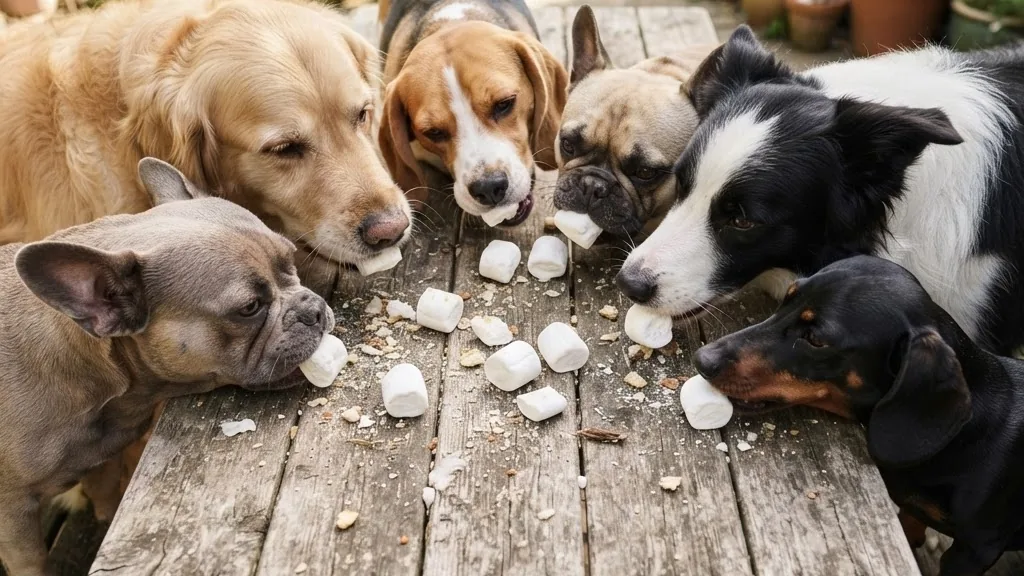
Can dogs eat marshmallows without landing in an emergency room? For a single plain marshmallow, the honest answer is usually yes, because nothing in the standard recipe is technically poisonous. The danger sits in what the bag does not advertise on the front, which is whether the manufacturer swapped ordinary sugar for xylitol.
Owners reach for a marshmallow as a fast reward the same way they might toss a berry or wonder whether sweet potatoes suit your dog. The candy is different in one specific way: some versions carry a risk that fruit and vegetables never will, and that risk can be fatal in a small dog before anyone notices a problem.
Quick answer: a plain, sugar-sweetened marshmallow is not toxic to a dog, so one stolen piece usually means nothing worse than a sugar spike or a loose stool. The genuine hazard is sugar-free or reduced-sugar candy sweetened with xylitol, which can crash blood glucose and injure the liver.
Before you decide whether dogs can eat marshmallows in your kitchen, read the ingredient list. If you see xylitol or birch sugar, treat any amount as a possible emergency and call a veterinarian or an animal poison control line without waiting for symptoms.
Can dogs eat marshmallows? The short verdict
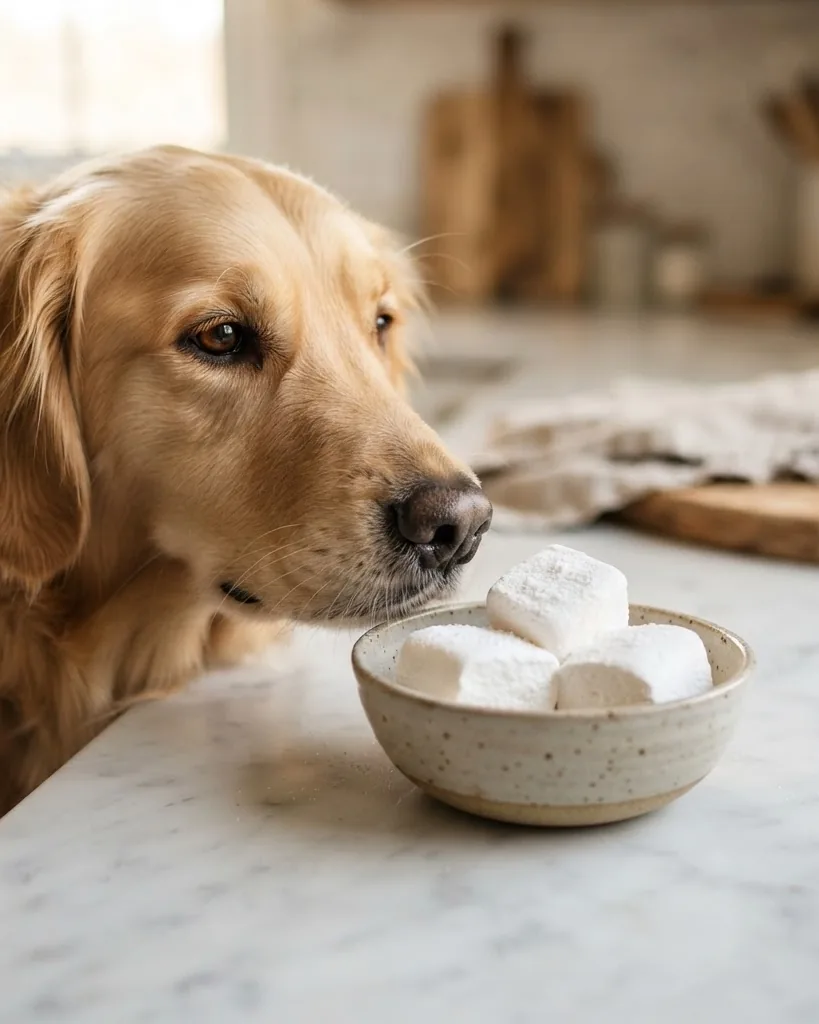
Can dogs eat marshmallows and be fine? A single plain marshmallow will not poison a healthy adult dog, and most animals pass it with no more than a brief sugar rush. That verdict holds only for the standard sugar recipe. It collapses the moment the label reads sugar-free, light, or reduced-calorie, because those products routinely swap sugar for xylitol.
So the real question is never the marshmallow by itself. It is the sweetener. A dog that grabs one classic campfire marshmallow needs watching, not panic. A dog that raids a bag of diet candy needs a phone call.
Keep two facts straight and you have most of the decision made:
- Plain, full-sugar marshmallow: not toxic, low-value junk, watch for stomach upset.
- Sugar-free or xylitol marshmallow: potentially life-threatening at any amount, act immediately.
Everything else in this guide flows from that split, from the exact doses to the timeline of symptoms.
Owners frequently ask a follow-up question at this point: does it matter how the marshmallow was eaten, whole versus chewed, or dry versus already dissolved in a cup of hot cocoa. It does not change the toxicity math. What changes the math is only the sweetener and the total weight of it your dog swallowed relative to its own body weight. A marshmallow melted into a drink is absorbed just as fast, sometimes faster, than one eaten whole.
What a marshmallow is actually made of
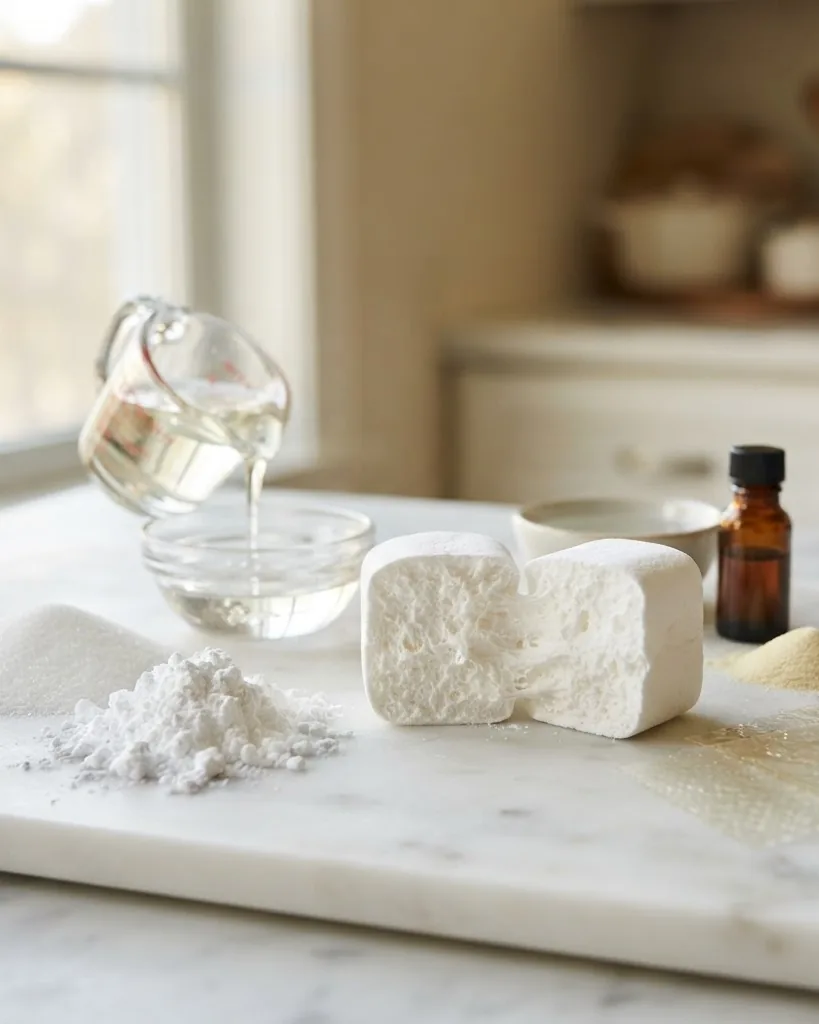
A marshmallow is mostly air whipped into sugar. The core recipe is granulated sugar, corn syrup or another glucose syrup, water, gelatin as the setting agent, a little vanilla, and a dusting of cornstarch and powdered sugar so the pieces do not stick.
None of that delivers the protein, fiber, or vitamins a dog needs, which is why the treat gets filed as empty calories. For a dog, one marshmallow is essentially sugar and gelatin with no nutritional payoff at all. The American Kennel Club lands on the same conclusion in its guidance on marshmallows for dogs, describing them as a no-nutrition snack rather than a true poison.
Gelatin is the one ingredient owners sometimes ask about. On its own it is a protein and is not dangerous to most dogs. The colorings and flavorings can occasionally upset a sensitive stomach, but they are not the reason a marshmallow ever becomes an emergency. That reason is always the sweetener, and it only appears in the diet versions.
Some specialty and imported marshmallows also add flavor oils, such as peppermint or coconut, or a chocolate coating. Peppermint oil in concentrated form can irritate a dog’s stomach, and a chocolate coating adds a second toxin on top of any sugar issue. Read the full ingredient panel, not just the front-of-bag description, since a bag labeled “gourmet” or “artisan” is not automatically safer than a plain grocery-store bag and can just as easily hide xylitol under the name birch sugar.
Xylitol is the real emergency, not the sugar
Xylitol is the single ingredient that turns a harmless candy into a poison-control call. It is a sugar alcohol used to sweeten sugar-free and reduced-sugar products, and dogs process it in a way no other common pet does.
In a person, xylitol barely nudges insulin. In a dog, the pancreas reads it as a flood of sugar and releases insulin at three to seven times the normal amount, according to figures compiled by Small Door Veterinary. Blood glucose then drops fast. That crash, called hypoglycemia, drives the vomiting, weakness, staggering, and seizures owners describe.
The Merck Veterinary Manual notes that dogs are the only domestic species in which this toxicosis has been documented, so a sweetener that is fine for the family is uniquely dangerous to the animal under the table. Cats, ferrets, and horses do not show the same insulin surge, which is one reason multi-pet households sometimes misjudge the risk, assuming that if the cat ignored the spilled candy the dog will be fine too.
The naming problem makes it worse. Xylitol hides on labels as birch sugar or wood sugar, so a product can look natural and still be toxic. It shows up in far more than candy: sugar-free gum, mints, some peanut butters, baked goods, chewable vitamins, cough syrups, and toothpaste. That is why a marshmallow is only one door into the same room.
The scale is not theoretical. Drawing on data from the ASPCA Animal Poison Control Center, the publication Today’s Veterinary Nurse reported 4,014 xylitol cases in a single year, with more than 75 percent tied to sugar-free gum.
One documented case at the Forest Hill Animal Clinic involved a Labradoodle that ate 57 sugar-free chewing gums, an exposure of roughly 2,100 mg/kg, with liver enzymes rising to about ten times normal within 24 hours. The U.S. Food and Drug Administration devoted a full Center for Veterinary Medicine consumer alert to the ingredient for exactly these reasons.
The dose that matters: 100 mg/kg and 500 mg/kg
Two thresholds decide how bad a xylitol exposure gets. The Merck Veterinary Manual places the hypoglycemia line at roughly 100 mg/kg, which works out to about 45 mg/lb of body weight. The far more serious liver-injury line sits near 500 mg/kg, or about 227 mg/lb.
Below the first number, a dog may show nothing. Between the two, expect a blood-sugar crash. At or above the second, the liver itself can start to fail. None of the top search results translate those figures into something an owner can use at 11 p.m., so here is the arithmetic. At 100 mg/kg and 500 mg/kg, the threshold dose scales directly with weight.
| Dog weight | Hypoglycemia dose (at 100 mg/kg) | Liver-injury dose (at 500 mg/kg) |
|---|---|---|
| 2 kg | 200 mg | 1,000 mg |
| 5 kg | 500 mg | 2,500 mg |
| 10 kg | 1,000 mg | 5,000 mg |
| 20 kg | 2,000 mg | 10,000 mg |
| 30 kg | 3,000 mg | 15,000 mg |
Read the table with one honest caveat. Manufacturers do not standardize how much xylitol goes into each sugar-free piece, and the amount can vary between flavors of the same brand.
That means you can calculate the dangerous dose for your dog by weight, but you often cannot know how many milligrams were in the candy your dog stole. When you cannot do the math, you assume the worst and call for advice.
Notice how brutally the small-dog column behaves. A 2 kg dog crosses the hypoglycemia threshold at just 200 mg, while a 30 kg dog needs 3,000 mg for the same effect. When a bag does not disclose its xylitol concentration, you have no reliable way to know how many milligrams a small dog actually swallowed. The safe default is to treat the unknown as if it were the higher figure, not the lower one.
The Cornell University College of Veterinary Medicine, through its Riney Canine Health Center, frames the same danger in terms of that rapid, oversized insulin release, and you can read its explanation of why xylitol is toxic to dogs for the physiology behind these numbers. The takeaway is blunt: the same bite that a Labrador shrugs off can hospitalize a Chihuahua.
How fast xylitol symptoms show up
Speed is the reason xylitol frightens veterinarians. Hypoglycemia can begin within 10 to 60 minutes of ingestion, the window the U.S. Food and Drug Administration cites in its own alert. VCA Animal Hospitals describes signs appearing as early as 30 minutes to two hours after a fast-absorbing product.
Slow-release forms, like some gums, can delay the crash by many hours, which lulls owners into thinking the danger has passed. Liver injury runs on a separate clock: necrosis can begin within 8 to 12 hours, enzymes climb between 12 and 48 hours, and outright liver failure may not appear until 24 to 48 hours after the candy went down.
What you are watching for shifts as those hours pass. Early, the picture is a blood-sugar crash. Later, it can become a liver problem, and a dog can develop one without ever showing the other first.
The signs owners should treat as urgent include:
- Vomiting, then unusual weakness or lethargy.
- Wobbling, a drunk-looking gait, or trouble standing.
- Tremors, collapse, or seizures.
- Later yellowing of the gums or eyes, which points at the liver.
Thirst and appetite changes matter too. If your dog starts acting off in ways that also show up when you are asking why a dog drinks so much water, do not wait to see whether it settles on its own after a possible xylitol exposure.
A practical troubleshooting note: do not rely on your dog’s appetite as reassurance. A dog that still wants breakfast an hour after eating sugar-free candy can still be building toward a crash, because the insulin surge and the resulting glucose drop do not always suppress hunger right away. Normal behavior soon after ingestion tells you almost nothing about what the next few hours hold.
Your dog ate a marshmallow: the next 30 minutes
Do one thing before anything else: find the bag and read the label. Your entire response splits on a single word. If the ingredients list sugar and no xylitol, and your dog ate a plain marshmallow or two, you are almost certainly watching a minor sugar event, not a poisoning.
If the label says sugar-free, light, or lists xylitol or birch sugar, you move into emergency mode regardless of how normal your dog looks right now. The absence of symptoms in the first few minutes means nothing, because the crash and the liver damage both run on a delay.
When xylitol is confirmed or even suspected, call for professional guidance immediately rather than searching for home fixes. Two lines exist for exactly this:
- The ASPCA Animal Poison Control Center, the toxicology service behind much of the published case data.
- Pet Poison Helpline, a 24/7 veterinary hotline that charges a per-incident fee covering follow-up calls for the case.
Do not induce vomiting on your own guess. That decision depends on timing and on whether signs have started, and the experts on those lines make it with you.
This is also not a moment for improvised medication. If you are tempted to reach for a human product, first read what is actually safe and toxic for canine pain relief, because the wrong bottle stacks a second poisoning on top of the first. Bring the packaging to the clinic so the team can estimate the dose.
If you cannot find the original packaging, write down what you do know: roughly how many pieces were missing, whether the bag was described as sugar-free or diet on the shelf, and what time you noticed the candy was gone. Poison control staff work with partial information constantly, and a rough estimate given quickly is more useful to them than a precise number given an hour late.
Roasted marshmallows and s’mores raise the stakes
A campfire marshmallow is rarely served alone, and that is the problem almost no guide addresses. A s’more pairs the marshmallow with chocolate, which is toxic to dogs on its own, so a begging dog that scores a whole s’more faces two hazards at once instead of one.
A freshly roasted marshmallow also comes off the stick hot and molten, which can burn a dog’s mouth or throat before it even reaches the stomach. The sticky, semi-liquid texture makes it easy for an eager gulper to inhale rather than chew.
Treat any camping or backyard dessert as off-limits for the dog, and keep the whole assembled snack, chocolate included, out of reach rather than trusting a quick grab will not happen. Graham crackers themselves are not dangerous, but they add nothing nutritionally either, so there is no upside to letting a dog finish a dropped s’more piece by piece.
At a group gathering, the more realistic failure mode is not a single dramatic theft but a slow accumulation: a piece here, a dropped stick there, a bowl of extra marshmallows left at dog height while the fire is tended. Assign one person to watch the dog around the fire pit, or crate the dog during the dessert stage of the evening, since prevention is far simpler than treatment.
Choking, weight, and teeth: the everyday risks
Even the plain, xylitol-free marshmallow is not a good idea on repeat. Its gummy, sticky texture is a genuine choking hazard for small dogs and for the kind of dog that swallows treats whole without chewing.
Beyond the acute risk, a marshmallow is close to pure sugar, so regular feeding pushes weight gain, dental decay, and the metabolic strain that raises diabetes risk over time. The fat-and-sugar combination in richer sweets can also provoke pancreatitis in susceptible dogs.
Diabetic dogs, overweight dogs, puppies, and toy breeds sit at the sharp end of all of this, and they are the same animals for whom even a small xylitol dose is most dangerous. A dog already managing diabetes with insulin injections faces a doubled risk from any sugar spike, plain or otherwise, since it complicates the glucose control the owner and vet are already working to maintain.
If you want a treat that rewards without the downside, swap the candy for something with real food value:
- Blueberries or a slice of apple with the seeds removed.
- Carrot sticks or a piece of banana.
- Vegetables prepared plainly, such as asparagus served safely for dogs or a modest portion of shrimp prepared with canine safety in mind.
These give a dog a reason to sit without teaching it to beg for a sugar hit. Rotate two or three of these options so the dog does not get bored, and keep portions small, since even a healthy fruit or vegetable can cause stomach upset if given in large quantity all at once.
Comparing marshmallows to other sugary temptations
Owners often ask how a marshmallow stacks up against other sweets that end up on the kitchen counter. Plain hard candy and plain marshmallows sit in roughly the same low-risk category, since both are mostly sugar with no toxic compound in the standard recipe. The risk profile changes the instant any of these products goes sugar-free, because xylitol shows up across the whole category, not just in marshmallows.
Chocolate is a different animal entirely and should never be compared to plain marshmallows as if the risks were similar. Chocolate contains theobromine, which is toxic to dogs at any concentration, with darker and more concentrated chocolate carrying more risk per gram. A marshmallow with no xylitol carries no equivalent baseline toxin, which is the core reason this guide treats plain marshmallows as a low-grade nuisance rather than a poison, while treating any chocolate-containing dessert as an automatic call to the vet.
Who governs xylitol labeling and poison response
Pet-food safety in the United States runs through a handful of named bodies, and knowing which does what helps you act fast in a crisis. The U.S. Food and Drug Administration regulates human and animal food labeling and issues consumer alerts, and its Center for Veterinary Medicine authored the standing warning about xylitol and dogs. That warning is the reason many labels now flag birch sugar at all.
The American Veterinary Medical Association sets the professional framework your veterinarian works within, while the American Kennel Club translates the science into owner-facing guidance.
The response side is where cost enters the picture for an owner. When a dog swallows something suspect, two toxicology services carry the load:
- The ASPCA Animal Poison Control Center, run by the American Society for the Prevention of Cruelty to Animals, whose case files supply much of the published dose data.
- Pet Poison Helpline, whose per-incident fee is billed once and then covers follow-up consultations through the rest of the case.
The reference works behind the clinical decisions are the Merck Veterinary Manual, reviewed with input from the ASPCA toxicologists, and hospital networks such as VCA Animal Hospitals that publish the patient-facing versions.
You can read the federal warning directly in the FDA’s own Paws Off Xylitol consumer update, and the Merck Veterinary Manual entry on xylitol toxicosis in dogs lays out the thresholds a clinician uses. For the hotline itself, the Pet Poison Helpline xylitol poison page explains when to call.
Common mistakes owners make with marshmallows
A few patterns show up again and again in xylitol case reports and in owner accounts of near misses. Recognizing them ahead of time is cheaper than learning them during an emergency.
- Assuming that because a cat or another dog in the house ignored the candy, the exposure was minor. Species and individual dogs respond differently, and one animal’s indifference tells you nothing about another’s dose.
- Waiting to see if symptoms appear before calling poison control, when the whole point of the delayed timeline is that waiting removes your treatment window rather than preserving it.
- Storing sugar-free candy at counter height or in a bag a dog can reach, on the assumption that a dog would not bother with something wrapped in plastic. Dogs regularly chew through packaging for a sugar smell.
- Trusting a front-of-bag label like natural or gourmet as proof the product is safe, instead of reading the ingredient panel for xylitol or birch sugar.
None of these mistakes require an unusual amount of neglect. They happen in careful households too, which is exactly why the label check and the saved poison-control number matter more than good intentions.
Frequently asked questions
Are mini marshmallows safer than big ones for dogs?
Not in the way that matters. A mini marshmallow holds less sugar, so it is a smaller junk-calorie hit, but that is the only advantage. If the product is sugar-free and contains xylitol, several small pieces can still push a light dog past the 100 mg/kg hypoglycemia threshold. Size does not change the poison, only the total dose.
My dog licked a marshmallow off the floor. Should I worry?
A lick or a single crumb of a plain, full-sugar marshmallow is very unlikely to cause anything beyond a possible loose stool. Check the label anyway. If the candy was sugar-free or listed xylitol, even a small amount warrants a call to your veterinarian or Pet Poison Helpline, since symptoms can begin within 10 to 60 minutes.
Is the marshmallow plant the same as the candy?
No. The marshmallow plant is a herb once used to make the original confection, and it is unrelated to the modern candy, which is sugar, corn syrup, gelatin, and flavoring. When people ask whether dogs can eat marshmallows, they almost always mean the bag of candy, and that is where the sugar and xylitol risks live.
Can puppies have a marshmallow?
Skip it. Puppies are small, so their body weight puts them close to the low end of every dose table, and a sugar-free piece reaches the hypoglycemia line at a tiny amount. Puppies also chew poorly and gulp, which makes the sticky texture a real choking hazard. Offer a safe fruit or vegetable instead of any marshmallow.
What if my dog ate a sugar-free marshmallow?
Treat it as an emergency and do not wait for symptoms. Sugar-free versions commonly use xylitol, which triggers an insulin release three to seven times the normal level. Call your veterinarian, the ASPCA Animal Poison Control Center, or Pet Poison Helpline right away, and bring the packaging so the team can estimate the dose against your dog’s weight.
Do marshmallows cause pancreatitis in dogs?
A single plain marshmallow is unlikely to trigger pancreatitis, but repeated sugary, fatty treats can in susceptible dogs. The concern grows with richer campfire versions and with dogs that are already overweight or prone to the condition. The safer move is to keep sugar treats occasional at most and reward with lower-sugar food instead.
How many plain marshmallows are too many for a dog?
There is no fixed cutoff, since the concern with plain marshmallows is cumulative sugar load rather than a single toxic dose. A small dog eating a handful in one sitting is more likely to see vomiting or loose stool than a large dog eating the same handful. Treat plain marshmallows as an occasional, single-piece reward rather than a snack given by the handful.
The bottom line for dog owners
Sort the question by the label and most of the fear disappears. Plain, full-sugar marshmallows are junk, not venom, so one stolen piece is a watch-and-wait situation rather than a crisis. Sugar-free candy is the opposite: xylitol can crash a dog’s blood sugar within an hour and injure the liver within a day, and the danger scales down hard as the dog gets smaller.
Keep the thresholds handy, 100 mg/kg for hypoglycemia and 500 mg/kg for liver injury, and keep a poison-control number saved before you ever need it.
If you are already rethinking what you feed, the same instinct that makes you cautious here pays off across the whole bowl, including knowing when low sodium dog food helps. Treats should earn their calories. A marshmallow almost never does.