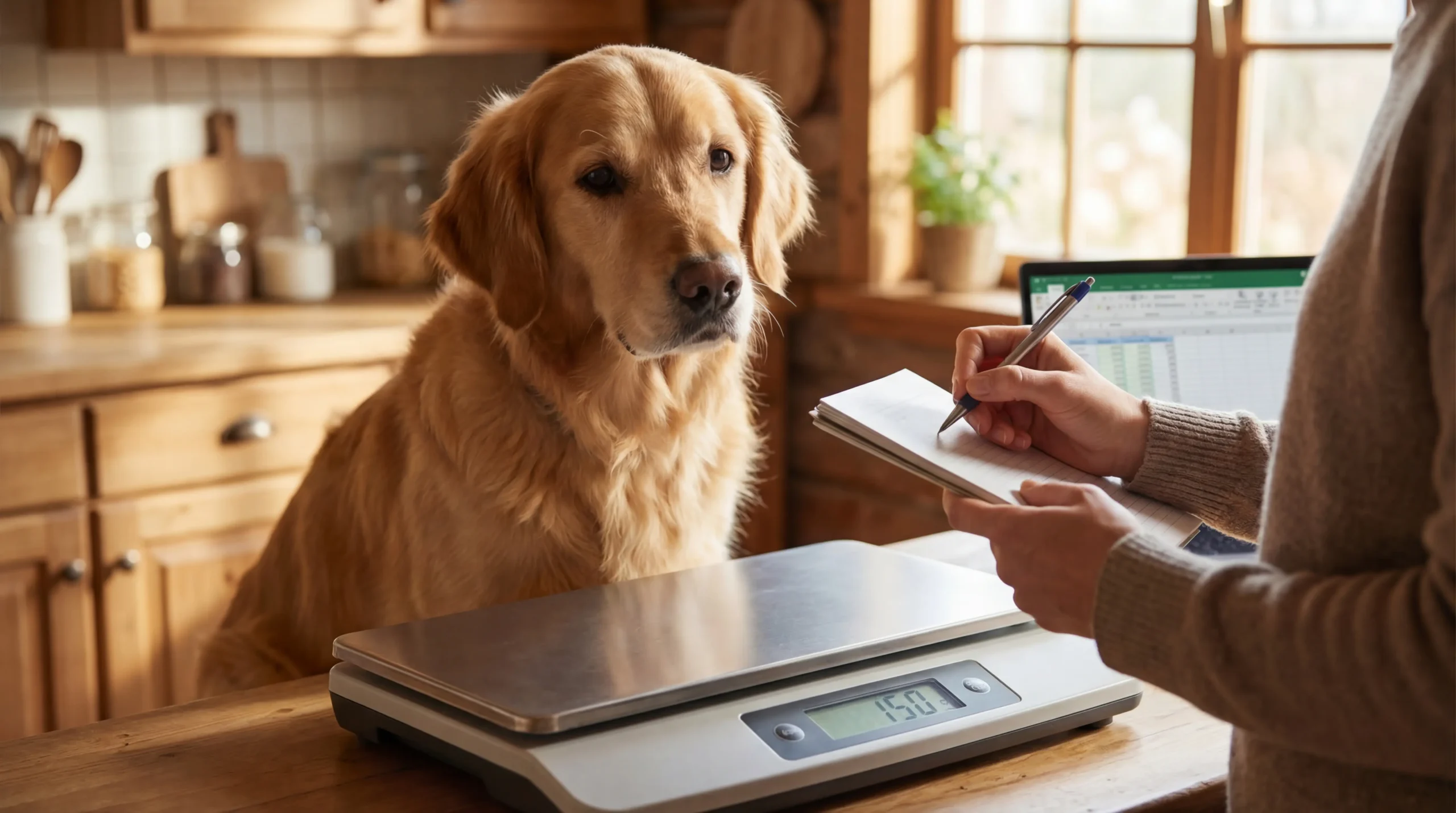

When I started tracking my dogs’ weight on a spreadsheet three years ago, I noticed something that changed how I think about diet food entirely. My older rescue was gaining weight despite eating the exact amount printed on her food bag. The feeding guide said she needed 1.5 cups per day for her size; my vet said she actually needed closer to 1 cup based on her activity level and metabolism. That 50% difference explained everything, and I remember sitting in the parking lot after that appointment feeling equal parts relieved and frustrated that I’d been overfeeding her for months without knowing.
Weight control dog food works by reducing caloric density while maintaining the nutrients your dog needs. The typical formula is lower in fat, higher in fiber, and contains ingredients like L-carnitine that support metabolism. But the food itself is only part of the equation. Most dogs on diet dog food still don’t lose weight because their owners follow the bag’s feeding guide rather than calculating what their specific dog actually requires.
Important: This article is for informational purposes only and is not veterinary advice. Consult your veterinarian before changing your dog’s diet or starting a weight loss program, especially if your dog has health conditions.
This guide covers how to assess whether your dog needs weight control dog food in the first place, what makes these formulas different from regular kibble, and the calorie math most feeding guides get wrong. I’ll also walk through the mistakes I see dog owners make repeatedly and when switching food alone won’t solve the problem. For the complete picture on choosing the right food for any dog, the Dog Food Selection Guide covers all the basics.
How to Tell If Your Dog Needs a Diet Food
The question isn’t whether your dog looks chubby. It’s whether you can assess their body condition accurately without guessing. I’ve misjudged my own dogs’ weight more than once, especially with my fluffier rescue whose coat hides her actual shape.
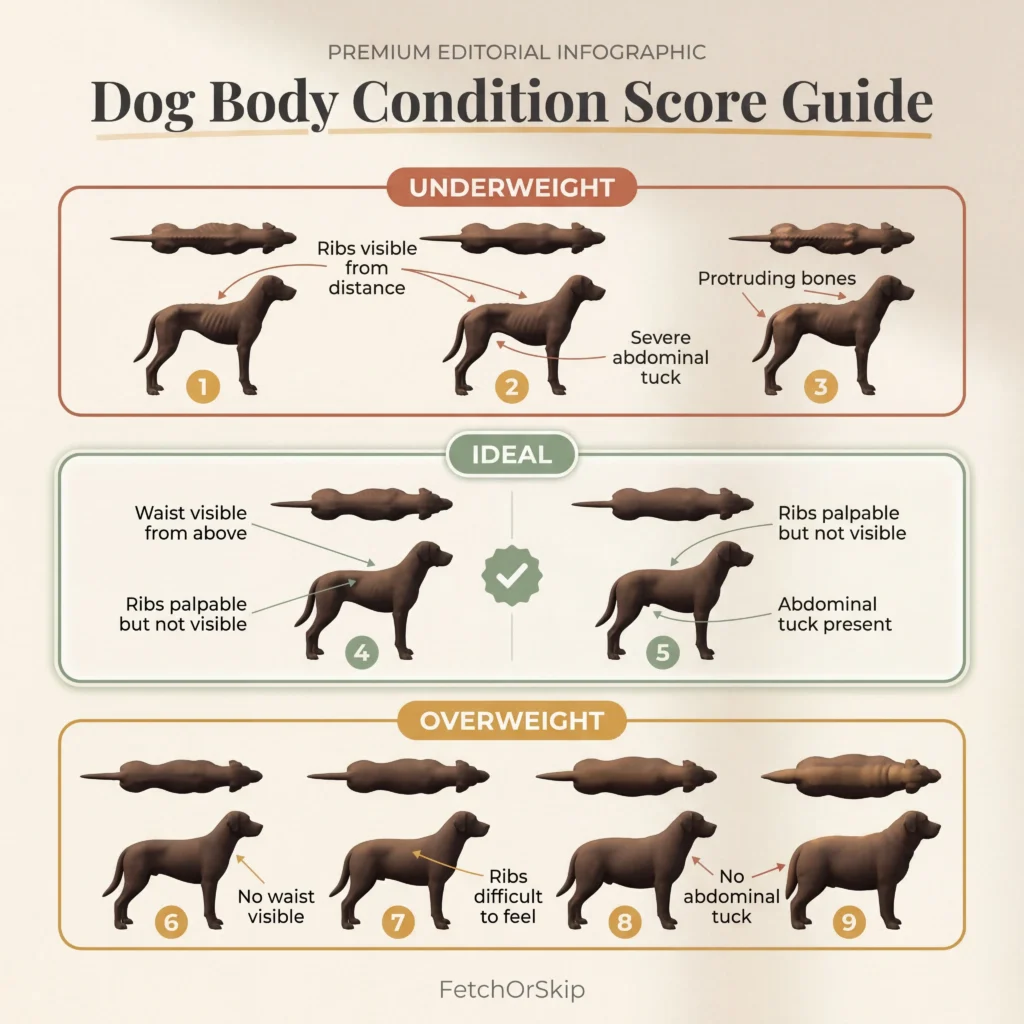
Body condition scoring gives you a standardized way to evaluate your dog’s weight that doesn’t depend on a number on a scale. The method involves two checks: visual and hands-on. From above, your dog should have a visible waist behind the ribs that curves inward slightly. From the side, their belly should tuck up from the ribcage rather than hanging level or sagging. With your hands, you should feel the ribs with light pressure, like checking if an avocado is ripe. If you have to press firmly to find them, or if the ribs aren’t detectable at all, your dog is carrying excess weight.
A body condition score of 6 or 7 out of 9 means your dog is overweight; 8 or 9 indicates obesity. At a 6, minor dietary adjustments like reducing treats or switching to a lower-calorie food may be sufficient. At 7 or above, a structured weight loss plan with your vet becomes more important.
The catch is that many owners score their dogs lower than they actually are because they’re used to seeing them at that size. I tracked my younger dog’s condition weekly for two months before I accepted she’d crept from a 5 to a 6 without me noticing.
Some breeds are genetically predisposed to weight gain and deserve extra attention: Labrador Retrievers, Beagles, Pugs, Golden Retrievers, Cocker Spaniels, and Dachshunds top the list. If you have one of these breeds, proactive weight monitoring matters even more. My vet once told me, “Labs will eat until they explode if you let them,” and while that’s an exaggeration, the underlying point stuck with me.
If you’re unsure about the assessment, your vet can score your dog and calculate their ideal weight range based on breed, frame size, and age. That number becomes your target; the weight control dog food becomes your tool for getting there.
What Makes Weight Control Food Different
Diet dog food isn’t regular kibble with smaller pieces. The formulation changes in ways that matter for both weight loss and nutritional balance over time.
The primary difference is caloric density, which simply means calories per cup. Weight management formulas typically run 250 to 300 calories per cup compared to 350 to 450 for standard adult food. That lower density allows you to feed a reasonable volume while reducing total calorie intake. Dogs eating diet food get a bowl that looks full even though it contains fewer calories. This distinction matters for satiety: a dog eating a tiny portion of regular food will feel hungrier than one eating a larger portion of diet food with the same calorie count.
The macronutrient balance shifts as well. Quality weight control dog food formulas contain higher protein, often 25% to 30% crude protein on a dry matter basis, to preserve lean muscle during weight loss. Fat drops significantly, sometimes to 8% to 12% compared to 15% to 18% in regular formulas.
Fiber content increases to promote fullness. Many brands add L-carnitine, an amino acid derivative that helps the body use fat for energy rather than storing it, essentially helping your dog burn calories more efficiently.
Wet vs Dry for Weight Loss
Both wet and dry weight control dog food can work for weight loss when portions are calculated correctly. Wet food creates a stronger sensation of fullness because of its higher water content, and some dogs find it more satisfying per calorie than dry kibble. I’ve used both with my dogs; the senior does better on a mix of wet and dry because she’ll lick the bowl clean and seem satisfied, while dry food alone leaves her looking for more. Cost per serving is typically higher for wet food, which factors into long-term sustainability. The data suggests either format can produce results if you’re consistent with measurements.
Worth comparing side by side: a weight management food’s guaranteed analysis versus your current food. Look at calories per cup on the side or back panel, crude protein percentage, and crude fat percentage. When I compared my dog’s old food to the diet formula my vet recommended, the calorie difference was substantial: 380 versus 260 per cup. That’s a 30% reduction without changing portion size.
One consideration is cost per serving rather than price per bag. Diet foods often cost more per pound, but if you’re feeding less volume to achieve the same calorie reduction, the daily cost might be comparable. I’ve found that mid-range diet formulas from brands that meet AAFCO feeding trial standards cost roughly the same per day as premium regular kibble once you adjust for serving size.
Related reading: dog food brands to avoid covers quality red flags that apply to diet formulas too.
Calorie Math for Dogs
This is where most diet plans fail before they start. The feeding guide on the bag is designed for an average dog at their current weight maintaining that weight. If your dog needs to lose weight, following that guide guarantees failure.
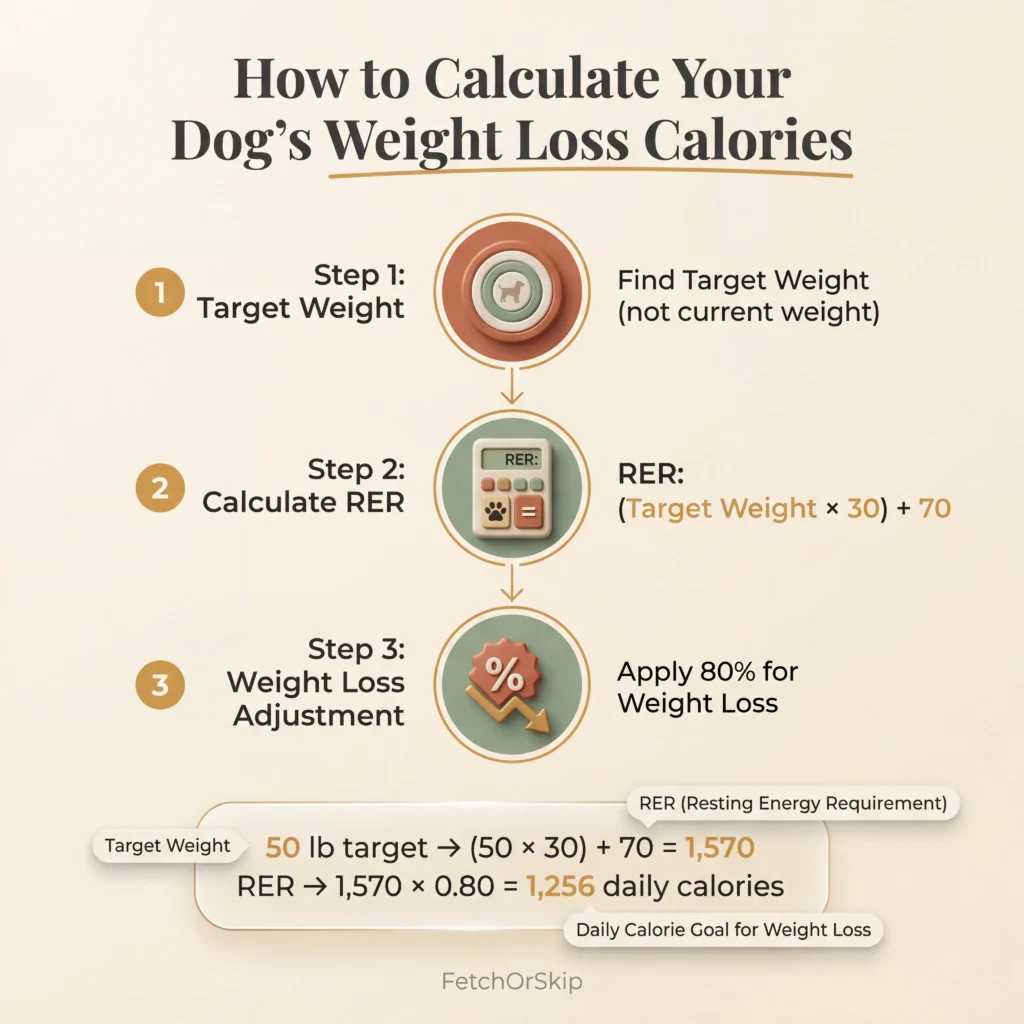
Your dog’s actual caloric need depends on their target weight, not their current weight. A 60-pound dog who should weigh 50 pounds needs calories calculated for a moderately active 50-pound dog, not a sedentary 60-pound one. The standard formula vets use is: target weight in pounds multiplied by 30, plus 70, which gives you the resting energy requirement. For weight loss, most dogs eat about 80% of that number.
Running the numbers for that 50-pound target: 50 times 30 plus 70 equals roughly 1,570 calories at resting energy requirement. For weight loss: 1,570 times 0.8 equals approximately 1,256 calories per day.
This formula provides a general starting point. Your veterinarian can calculate a more precise target based on your dog’s breed, age, activity level, and health status. Never restrict calories aggressively without veterinary supervision, as too-rapid weight loss can cause muscle wasting and nutritional deficiencies.
If the diet food provides 260 calories per cup, that’s about 4.8 cups daily for our example dog. Compare that to a bag’s feeding guide that might suggest 3 cups for a 60-pound dog eating standard food at 380 calories per cup, and you see how the numbers shift.
I tracked this with my senior dog over eight months. Her vet calculated a target of 900 calories daily for weight loss. I weighed her food on a kitchen scale because gram measurements are more accurate than cup scoops, and I logged everything including treats. She lost 6 pounds over that period, which put her back in the healthy range for her size. The spreadsheet showed that on weeks where I estimated portions by eye rather than weighing, her weight loss stalled.
The feeding guide on the bag commonly overestimates by a significant margin for dogs who need to lose weight. Veterinary nutritionists I’ve read suggest this can be 20% to 30% higher than what an individual dog actually needs. That’s not the manufacturer’s fault; they’re providing general guidance for maintenance, not weight loss. Your vet can calculate the specific caloric target for your dog, and from there, the math is straightforward.
Related: low protein dog food covers situations where protein levels matter beyond just weight management.
Common Mistakes That Stall Weight Loss
Even with the right weight control dog food and calculated portions, weight loss can plateau. I’ve made most of these mistakes myself.
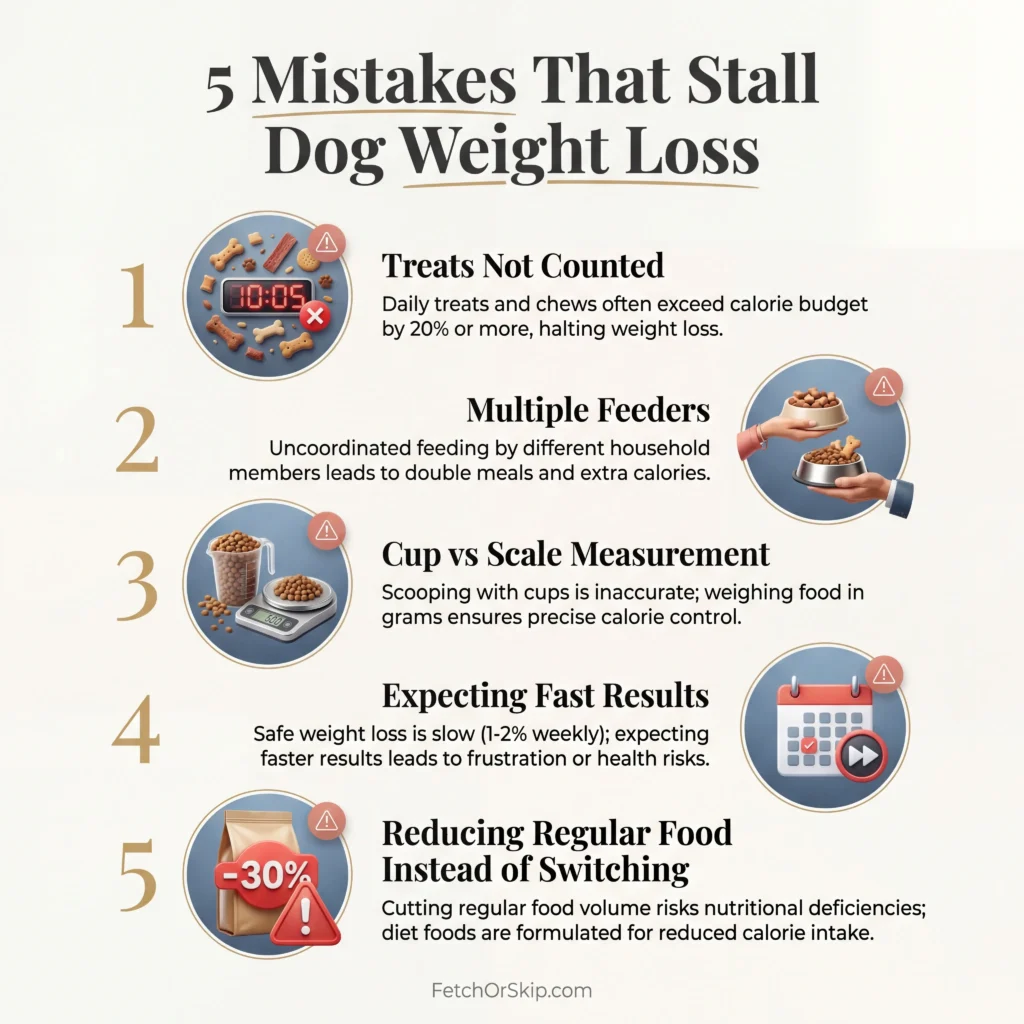
Treats aren’t in the calorie budget. Those training treats, dental chews, and table scraps count. If your dog’s daily target is 900 calories and you’re giving 200 calories in treats on top of their food, you’ve exceeded maintenance by 20%. I started breaking treats into smaller pieces and switched to lower-calorie options like plain cooked green beans and baby carrots. Sable covers which vegetables are safe in her vegetable safety guide if you want alternatives.
Multiple people feeding the same dog creates invisible calories. In households with more than one person, the dog often gets fed twice or receives extra treats from everyone. We solved this by keeping a whiteboard in the kitchen: whoever fed the dog marked the time and amount. My husband thought I was being ridiculous until we realized he’d been giving “just a few” training treats every evening that added up to 150 calories daily. Sounds excessive; works perfectly.
Cup measurements vary wildly. A “cup” scooped loosely from the bag can contain 20% more food than a level cup measured properly. I switched to weighing food in grams after realizing my cup scoop was inconsistent. A kitchen scale costs less than a bag of dog food and pays for itself in accuracy.
Expecting fast results leads to frustration or dangerous shortcuts. Safe weight loss for dogs runs 1% to 2% of body weight per week. For a 50-pound dog, that’s half a pound to one pound weekly. Weight loss that’s faster often means muscle loss, not just fat loss. My dog’s 6-pound loss over eight months averaged about 0.75 pounds per month, well within the safe range. I had to remind myself that slow progress was still progress.
Reducing portions of regular food instead of switching seems logical but backfires nutritionally. Cutting portions of regular food by 30% to reduce calories also cuts nutrients by 30%. Diet foods are formulated to maintain complete nutrition at lower calorie levels. That’s the entire point of the formulation, and it’s why even the best weight control dog food intentions fail when owners just feed less of their normal kibble.
The dogs who stall on weight loss plans are almost always consuming more calories than their owners realize. Track everything for two weeks: weighed food portions, every treat, any table scraps. The data usually reveals the problem.
When Food Alone Is Not Enough
Some dogs won’t lose weight on diet food regardless of accurate portioning. That’s when the conversation shifts beyond nutrition.
Underlying health conditions can interfere with weight loss. Hypothyroidism slows metabolism and makes weight loss difficult even at appropriate calorie levels. Cushing’s disease causes weight gain and increased appetite. If your dog has been on a properly calculated diet for two to three months without losing weight, bloodwork to check thyroid function and cortisol levels is worth discussing with your vet.
Mobility limitations create a cycle where dogs can’t exercise enough to support weight loss, and excess weight makes mobility worse. Dogs with arthritis, hip dysplasia, or other joint conditions may need a combination approach: diet food, weight management supplements with glucosamine, and low-impact exercise like swimming or short leash walks. For large breeds especially, large breed dog food formulations address joint support that matters during weight loss.
Prescription weight loss diets exist for dogs who haven’t responded to over-the-counter options. Brands like Hill’s Prescription Diet Metabolic and Royal Canin Satiety Support are formulated more aggressively than standard diet foods and require veterinary authorization. These aren’t first-line options; they’re for dogs who need more intervention than commercial weight management formulas provide.
One factor that surprised me: spayed and neutered dogs often have lower metabolic rates than intact dogs. Some research indicates that caloric needs may drop significantly after these procedures, with estimates ranging from 20% to 30%, though individual variation is substantial. If your dog was fixed as an adult and gained weight afterward, their maintenance calories may be lower than you’d expect based on size alone. Ask your vet for guidance specific to your dog rather than relying on general estimates.
Weight loss in dogs requires the same fundamentals as in humans: calories consumed must be less than calories burned. Food controls the input side. Exercise, metabolism, and health status affect the output side. When the food adjustment isn’t working, the issue is usually on the output side or in uncounted inputs.
FAQ
Is wet or dry dog food better for weight loss?
Wet food creates a stronger sensation of fullness because of its water content, and some dogs find it more satisfying per calorie than dry kibble. In my experience, either can work for weight loss if portions are calculated correctly. My senior dog does better on a mix because the wet food makes her feel like she’s gotten a substantial meal. Cost per serving is typically higher for wet food, which factors into whether it’s sustainable for your budget long-term. The format matters less than the consistency of your measurements.
How long does it take for a dog to lose weight on diet food?
Safe weight loss runs 1% to 2% of body weight per week. A 50-pound dog losing half a pound weekly would take 10 weeks to lose 5 pounds. In my experience tracking weight loss across three dogs, the timeline stretches longer than expected because of plateaus and the occasional week where treats creep back up. You should notice improvements in energy and coat quality within three to four weeks even before the scale moves dramatically. Budget three to six months for meaningful results; expecting faster outcomes usually leads to frustration or unsafe calorie restriction.
Should I feed my dog less of their regular food instead of switching to diet food?
Reducing portions of regular food cuts nutrients proportionally with calories. If you cut food by 30%, you’re also cutting protein, vitamins, and minerals by 30%, which can lead to deficiencies over time. Weight management formulas are specifically designed to maintain complete nutrition at reduced calorie levels. The formulation difference matters more than most owners realize, and it’s why veterinary nutritionists generally recommend switching rather than just reducing.
Can I add toppers to weight control dog food?
Toppers add calories that need to fit within your dog’s daily budget. Plain pumpkin puree, not pie filling, adds fiber and moisture with minimal calories, which supports satiety. Bone broth without added salt works similarly. Avoid high-fat toppers like cheese or fatty meat scraps that can offset the calorie reduction from diet food. I use a tablespoon of pumpkin occasionally and count it as roughly 5 calories. Related: dog food toppers covers which additions are worth it and which to skip.
Do weight control dog foods work for all breeds?
The caloric density and macronutrient balance work across breeds, but portion calculations vary significantly. A Chihuahua and a Labrador both benefit from reduced-calorie formulations, but the feeding amounts and calorie targets differ enormously. Breeds prone to obesity like Labradors, Beagles, Pugs, and Golden Retrievers may need more aggressive calorie restriction than breeds with higher metabolisms. Your vet can help determine the appropriate target for your dog’s specific breed and activity level, which is more reliable than using breed-average charts.
When should I NOT use weight control dog food?
Diet formulas aren’t appropriate for every dog. Puppies still growing need calorie-dense nutrition for proper development. Pregnant or nursing dogs have increased caloric demands. Very active working dogs, hunting dogs, or athletic dogs may need more calories than diet food provides. Dogs recovering from illness or surgery often need higher-calorie diets to heal. And some senior dogs who are already thin shouldn’t be on calorie-restricted food even if they’re less active. If your dog falls into any of these categories, talk to your vet before switching to a weight management formula.
Making the Switch Work
Changing your dog’s food and watching them lose weight sounds straightforward in theory. The execution requires tracking, consistency, and patience that most feeding guides don’t mention.
Start by getting a baseline: your dog’s current weight, body condition score, and daily calorie intake including all treats and scraps. Have your vet calculate a target weight and daily calorie goal. Choose a weight control dog food that fits your budget and your dog’s preferences, then transition gradually over 7 to 10 days to avoid digestive upset. Weigh portions on a gram scale. Track everything.
Expect slow progress. Celebrate the weeks where weight moves in the right direction; don’t panic over small fluctuations. Weight varies by hydration, meal timing, and whether your dog has used the bathroom recently. Trends over weeks matter more than daily numbers.
Read the ingredient panel before you read the reviews. Marketing claims like “weight management” or “healthy weight” aren’t regulated the way you might expect; the guaranteed analysis and calorie content per cup are what actually matter. The Dog Food Selection Guide covers how to compare formulas if you’re evaluating multiple options.
Your dog’s response to the food matters more than any brand’s claims about it. If they’re not losing weight on calculated portions after two months, something in the equation needs adjustment. The weight control dog food is one variable; treats, activity, health conditions, and measurement accuracy are the others.
Start today: weigh your dog, assess their body condition score using the rib test and waist check, and schedule a vet appointment to discuss a calorie target. Next week, you’ll have a plan instead of a guess.
— Liora Kittredge
