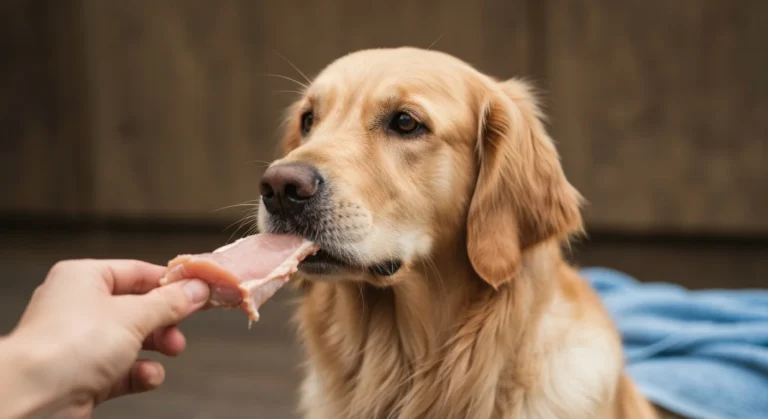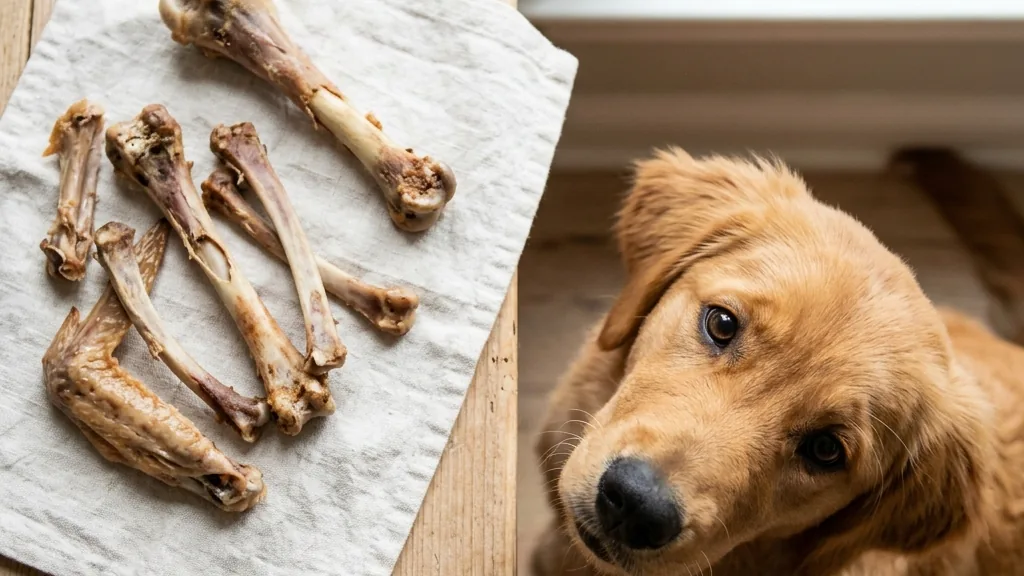
Can dogs eat turkey bones? No. Turkey bones, and especially cooked ones, are among the most dangerous things a dog can swallow. Whether the bone comes from a roast dinner, a deli sandwich, or the trash, a cooked turkey bone can splinter into sharp shards that choke a dog, tear the throat, or puncture the stomach and intestines. If your dog has already eaten one, skip to the emergency section below and call your veterinarian or the ASPCA Animal Poison Control Center at 888-426-4435 right away.
This guide explains exactly why turkey bones are risky, the difference between cooked and raw bones, the warning signs to watch for over the next 24 to 72 hours, what to do (and what not to do) if your dog swallows one, and the safer ways to share turkey with your dog.
The Short Answer: Turkey Bones Are Not Safe for Dogs
Veterinary organizations are consistent on this point. The American Kennel Club and the ASPCA Animal Poison Control Center both advise that if you share turkey with your dog it must be boneless and well cooked. The American Veterinary Medical Association (AVMA) likewise lists bones and bone fragments among the common household hazards that send dogs to the emergency room, and federal regulators have warned consumers that even packaged “bone treats” have been linked to choking, blockages, and dozens of pet illnesses.
It is worth being clear about what “turkey bones” means here, because it covers more than the drumstick. (Turkey meat itself is a different question, covered in our guide to whether dogs can eat turkey safely.) The wishbone, the carcass, neck bones, wing bones, and the small fragments left on a plate are all hazards. A dog that counter-surfs a Thanksgiving carcass or digs a wing bone out of the garbage is at exactly the same risk as one that is handed a bone on purpose.
Why Cooked Turkey Bones Are So Dangerous
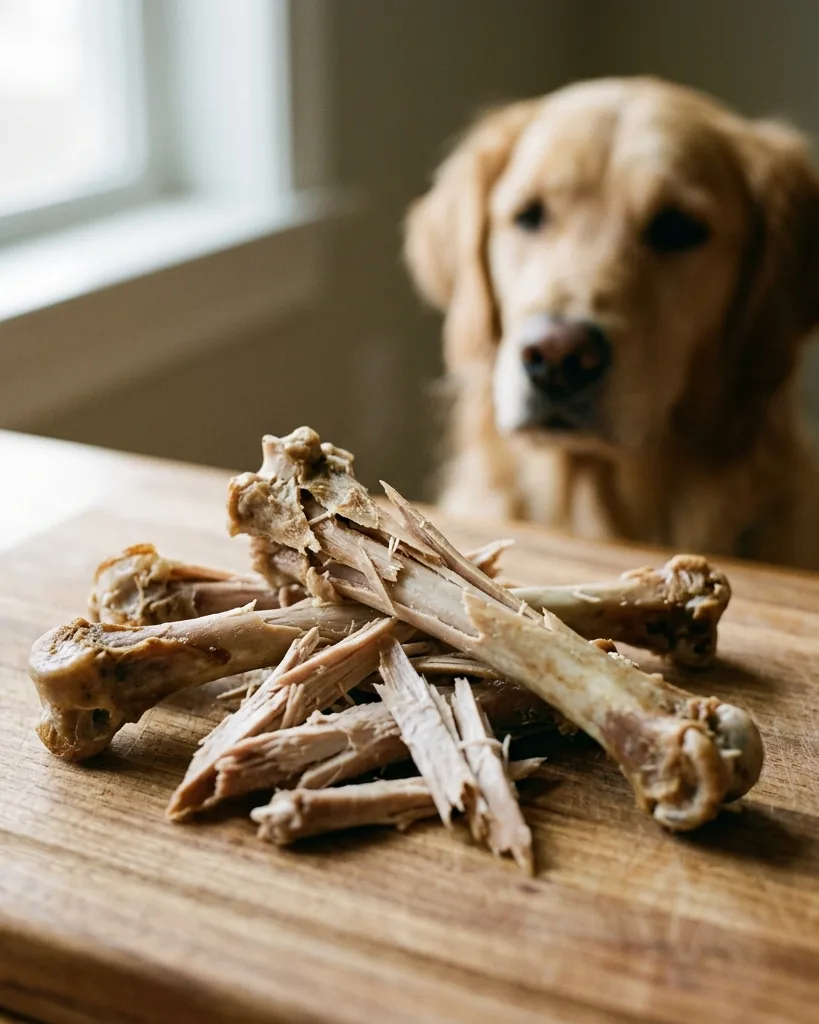
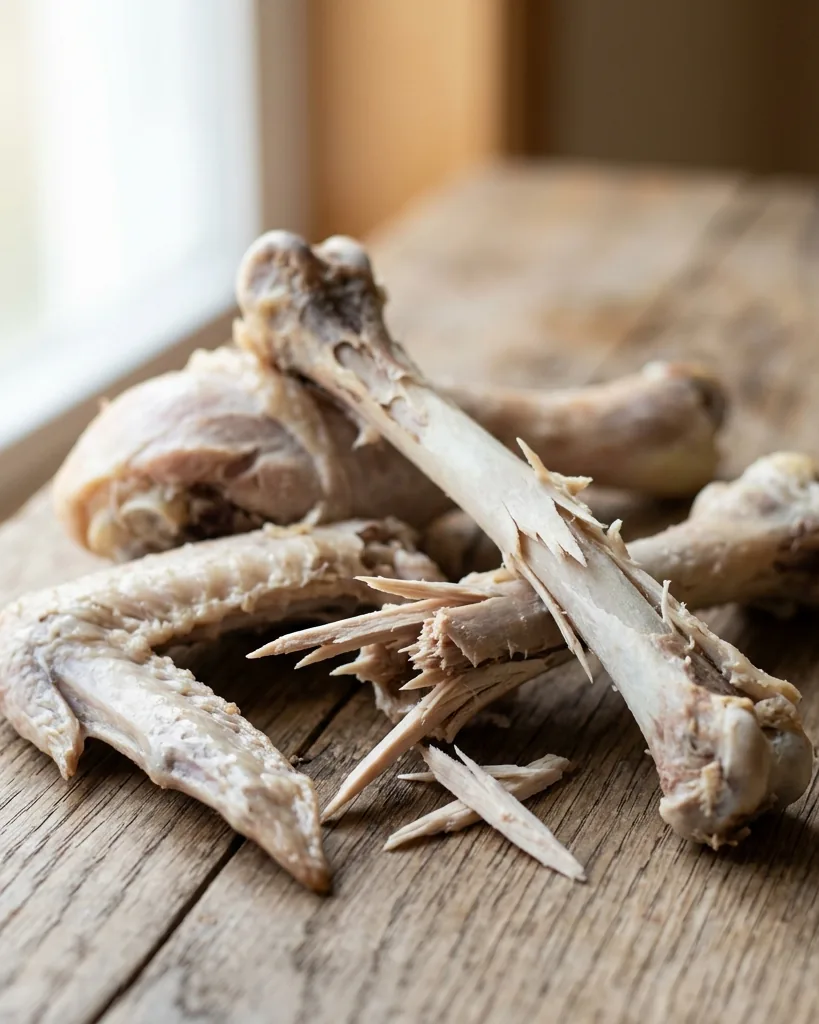
Turkey is poultry, and poultry bones are hollow with thin walls. That structure is light enough for a bird to fly, but it is also the reason the bones are fragile. When you cook a turkey, the heat dehydrates the collagen and moisture inside the bone. A cooked bone is no longer flexible – it is dry and brittle, so instead of crushing into soft, chewable chunks the way a fresh bone might, it cracks lengthwise into long, needle-sharp splinters.
Those splinters are the problem. A single shard can cause damage at any point along the digestive tract, and a dog can run into trouble within minutes or not show symptoms for days. Here are the five main injury pathways veterinarians worry about:
- Mouth and throat: Sharp fragments lodge in the gums, between teeth, in the tongue, or across the roof of the mouth. A larger piece stuck at the back of the throat causes choking and gagging.
- Esophagus: A shard can wedge in the esophagus (an esophageal foreign body), leading to drooling, repeated swallowing, retching, and regurgitation. This often needs to be removed under sedation with an endoscope.
- Stomach and intestines: A sharp edge can perforate – puncture – the wall of the stomach or intestine. A perforation allows digestive contents to leak into the abdominal cavity and cause peritonitis, a severe, life-threatening infection.
- Obstruction: Several fragments can clump together and block the intestine partially or completely. A complete obstruction is a surgical emergency; without surgery it is frequently fatal.
- Constipation and rectal injury: Bone fragments pack into hard, dry stool. The dog strains to pass it, which can cause painful defecation, bleeding, and tears near the rectum.
Cooked vs. Raw Turkey Bones: Is There a Difference?
You will sometimes hear that raw bones are “safer” than cooked ones, and mechanically there is some truth to it: a raw bone retains moisture and flexibility, so it tends to bend or crush rather than shatter into needles. That is why the raw-feeding community uses raw recreational bones.
But “safer than the most dangerous option” is not the same as “safe.” Raw poultry bones still carry two real risks. First, they can splinter – just less reliably than cooked ones. Second, raw poultry can carry Salmonella and Campylobacter, bacteria that can make both your dog and your household sick. The bottom line for the everyday owner is simple: the turkey bone on your dinner table is cooked, and cooked turkey bones are the single worst kind. Do not give them, and do not let your dog scavenge them. For the bigger picture on bones of every type, see our full dog bone safety guide.
Symptom Timeline: What to Watch for Over 24 to 72 Hours
A swallowed bone can cause problems anywhere from the throat to the colon, and the timing depends on where the fragment travels and lodges. Veterinarians generally recommend watching a dog closely for 24 to 72 hours after a bone is eaten. The following timeline shows what tends to appear and when.
| Time after eating the bone | What to watch for | What it may mean |
|---|---|---|
| 0-2 hours | Choking, gagging, pawing at the mouth, heavy drooling, retching | A fragment stuck in the mouth, throat, or esophagus – act immediately |
| 2-24 hours | Vomiting, refusing food, restlessness, drooling, lethargy | Irritation or a fragment in the stomach or upper intestine |
| 24-48 hours | Repeated vomiting, hard or swollen belly, hunched posture, no appetite | Possible obstruction – most blockages show signs in this window |
| 24-72 hours | Straining to poop, constipation, bloody or black tarry stool, weakness | Fragments in the lower bowel, or internal bleeding from a perforation |
Many fragments do pass on their own. A small shard that clears the stomach may move through the digestive tract in roughly 8 to 72 hours and leave in the stool with no harm done. The trouble is that you cannot tell from the outside which bone will pass quietly and which one will lodge or perforate, which is why the monitoring window matters so much.
Red-Flag Symptoms: When to Get to the Vet Now
Some signs mean you should not wait and watch – you should call an emergency veterinarian or head to the clinic immediately:
- Choking, blue-tinged or pale gums, or collapse
- Repeated, unproductive vomiting or retching
- A hard, distended, painful abdomen, or a dog that hunches and won’t lie down comfortably
- Bloody vomit, or black, tarry stool
- Straining to defecate with nothing passing
- Lethargy, weakness, or a refusal to eat or drink lasting more than a few hours
Smaller dogs are at higher risk, simply because the diameter of their esophagus and intestines is smaller. A bone fragment that an 80-pound Labrador might pass can obstruct a dog under 20 lb. Puppies and senior dogs also tend to do worse, so lower your threshold for calling the vet with them.
What to Do If Your Dog Already Ate a Turkey Bone
If you have just discovered that your dog swallowed a turkey bone, stay calm and work through these steps in order.
1. Do not induce vomiting
This is the most important rule, and it is counterintuitive. With a sharp object like a bone shard, making your dog vomit can cause as much damage on the way up as the bone did going down – it can lacerate the esophagus or get stuck. Do not give hydrogen peroxide or any home remedy to force vomiting unless a veterinarian specifically tells you to.
2. Take away any remaining bones and check the mouth
Remove the carcass, plate, or trash so the dog can’t eat more. If your dog is calm and will let you, gently look in the mouth for a visible, easy-to-reach fragment. Do not push your fingers down the throat or try to dig out anything lodged deep – you can push it further in.
3. Call your veterinarian or a poison hotline
Call your own veterinarian, an emergency clinic, or a 24/7 poison hotline and tell them your dog’s weight, roughly how much bone was eaten, and when. Two hotlines are staffed around the clock:
- ASPCA Animal Poison Control Center: 888-426-4435, available 24 hours a day, 365 days a year (a consultation fee may apply).
- Pet Poison Helpline: 855-764-7661 (an incident fee applies).
4. Follow the vet’s guidance – don’t improvise
Some veterinarians, depending on the situation, may suggest feeding a small amount of plain white bread or a spoon of plain canned pumpkin to help cushion fragments as they move through the gut. Only do this if your vet tells you to. Do not give laxatives, mineral oil, or bone-softening home remedies on your own.
5. Watch closely for the next three days
Even if your dog seems fine, keep a close eye on appetite, energy, vomiting, and every bowel movement for a full 24 to 72 hours. Note anything unusual and report it. If your vet asks you to check the stool, you are looking to confirm the fragments have passed.
How Vets Diagnose and Treat a Swallowed Bone
If your dog is symptomatic, the veterinary team will usually start with a physical exam and imaging. Bone is dense, so it often shows up on an X-ray, though not every fragment is visible and gas patterns can also hint at an obstruction. An ultrasound or a contrast study may be added.
Treatment depends on where the bone is and what it is doing. A fragment in the esophagus or stomach can sometimes be removed with an endoscope under anesthesia, avoiding surgery. A bone causing a true intestinal obstruction or a perforation, however, usually requires abdominal surgery to remove the fragment and repair the damage. That is a major procedure: depending on the region and severity, obstruction surgery commonly runs from roughly $1,500 to $5,000 or more, which is one more reason prevention is so much easier than the cure.
Can Dogs Eat Turkey at All? Yes – Just Not the Bones
The good news is that turkey meat itself is a lean, dog-friendly protein, and it appears in many commercial dog foods. The danger is in the bones and the trimmings, not the meat. To share turkey safely:
- Serve it boneless and well cooked. Remove every bit of bone first.
- Skip the skin and the fat. Fatty turkey skin can trigger an upset stomach or, in some dogs, pancreatitis.
- No seasoning. Garlic and onion – common in stuffing, gravy, and rubs – are toxic to dogs. Salt, butter, and gravy are also off the menu.
- Keep portions small. A few bite-sized pieces of plain breast meat as a treat is plenty, especially the first time.
If your dog has a health condition or has never had turkey, check with your veterinarian before adding it, and introduce it in small amounts to watch for any digestive upset.
Safer Chews Than Bones
If part of the appeal of a turkey bone is giving your dog something satisfying to gnaw, there are far safer ways to scratch that itch:
- Veterinary-approved dental chews sized for your dog
- Durable rubber or nylon chew toys, including ones you can stuff with food
- Frozen, food-stuffed toys for long-lasting enrichment
The same caution from the AVMA’s household-hazards guidance applies here too: packaged “bone treats” have been linked to choking, blockages, and injuries, so they are not the safe shortcut they look like. When in doubt, ask your veterinarian which chews are appropriate for your dog’s size and chewing style.
Other Holiday Table Hazards to Keep Away From Dogs
Turkey bones rarely sit on the table alone. The same meals that put bones within reach also bring a lineup of other foods that are risky or outright toxic for dogs. If you are guarding against bones, guard against these at the same time:
- Turkey skin, fat, and drippings: A sudden hit of greasy, fatty food can trigger pancreatitis – a painful inflammation of the pancreas that can land a dog in the hospital. Trimmings and the fat scraped off a roasting pan are common culprits.
- Onions, garlic, leeks, and chives: These are toxic to dogs and hide in stuffing, gravy, casseroles, and seasoning rubs. They can damage red blood cells and cause anemia, sometimes a few days after the meal.
- Ham bones and rib bones: Just like turkey bones, cooked pork and beef bones splinter and obstruct. Ham also tends to be very salty and fatty.
- Corn cobs: A classic cause of intestinal obstruction. Dogs swallow chunks of cob that do not break down and lodge in the gut.
- Grapes and raisins: Even small amounts can cause kidney failure in some dogs. Keep fruitcake, stuffing with raisins, and grape platters out of reach.
- Chocolate and anything with xylitol: Chocolate (especially dark and baking chocolate) and the sugar substitute xylitol – found in some baked goods, gum, and peanut butter – are both dangerous and can be life-threatening.
- Alcohol and rising bread dough: Both are hazardous; raw dough can expand in the warm stomach and ferment into alcohol.
If your dog gets into any of these, the same hotlines apply: your veterinarian, the ASPCA Animal Poison Control Center at 888-426-4435, or the Pet Poison Helpline at 855-764-7661.
Prevention: Keeping Turkey Bones Out of Reach
Almost every turkey-bone emergency is preventable, and prevention is far cheaper and less frightening than treatment. A handful of habits eliminate most of the risk:
- Manage the trash. Carcasses are a magnet for counter-surfing and trash-raiding dogs. Use a lidded, latched, or behind-a-door can, and take bone-heavy garbage out promptly. A determined dog will tip an open bin the moment you leave the room.
- Clear plates immediately. Don’t leave bone-laden plates on the coffee table or within reach of a quick nose. Scrape and rinse before the dog gets a chance.
- Brief your guests. The most common way a careful owner’s dog ends up at the emergency clinic is a well-meaning guest who slips “just a little” off their plate. Tell everyone, kids included, that no bones and no table scraps go to the dog.
- Crate or gate during the meal. For a determined scavenger, the simplest fix on a busy holiday is to give the dog a safe space with a long-lasting chew while food is out.
- Watch the outdoors, too. Bones get tossed in yards, parks, and on walks. A reliable “leave it” cue is one of the most valuable safety skills you can teach.
Frequently Asked Questions
What happens if a dog eats a small turkey bone?
Sometimes nothing – a small fragment may pass through the digestive tract in 8 to 72 hours and leave in the stool. But a small shard can also lodge in the throat, perforate the gut, or contribute to a blockage. Because you can’t predict which will happen, call your vet and monitor your dog closely for 24 to 72 hours.
Should I make my dog throw up the bone?
No. Do not induce vomiting after a dog swallows a bone unless a veterinarian specifically tells you to. A sharp shard can injure the esophagus on the way back up or become lodged. Call your vet or the ASPCA Animal Poison Control Center at 888-426-4435 for guidance instead.
Are raw turkey bones safer than cooked ones?
Raw bones are less brittle and splinter less readily than cooked bones, but they are not risk-free – they can still splinter and they can carry Salmonella and Campylobacter. Cooked turkey bones, the kind on your dinner table, are the most dangerous of all and should never be given.
How long after eating a bone will a dog show symptoms?
It varies. Choking or throat problems appear within minutes. Stomach and intestinal signs often show up within 24 to 48 hours, and lower-bowel issues can appear anytime in the first 24 to 72 hours. That is why the standard advice is to watch closely for three full days.
My dog ate a turkey bone and seems totally fine – do I still need to worry?
Possibly. Many dogs do pass small fragments without trouble, but obstructions and perforations can develop hours later. Call your veterinarian to describe what happened, watch appetite, energy, vomiting, and stool for 24 to 72 hours, and go in immediately if any red-flag sign appears.
What’s a safe way to give my dog turkey on the holidays?
Offer a small amount of plain, boneless, well-cooked turkey breast with no skin, no fat, and no seasoning, gravy, garlic, or onion. Keep it to a few bites as a treat, and keep the carcass and trimmings well out of reach.
This article is for general educational purposes and is not a substitute for professional veterinary care. If you are worried about your dog, contact your veterinarian or an emergency clinic right away.