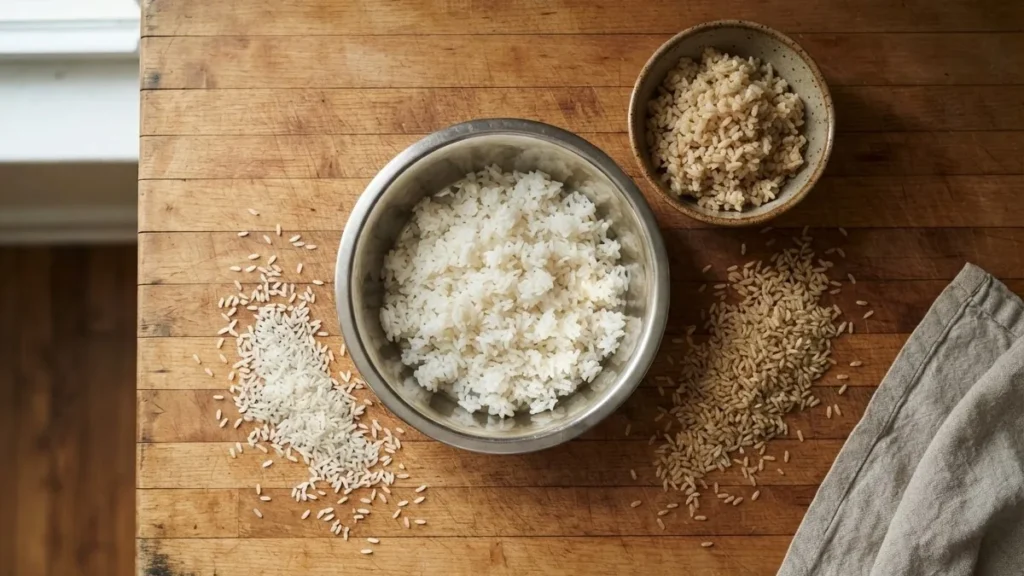
Can dogs eat rice? Yes, plain cooked white rice is safe for most healthy dogs in small amounts, and it is one of the few human foods veterinarians actively hand back to owners as a tool rather than a hazard. The catch is that almost nobody tells you how much, how often, or what changes when your dog is diabetic, overweight, or recovering from a bout of vomiting. It is a carbohydrate and an energy source, not a complete meal, and the difference between a helpful spoonful and a slow nutritional problem comes down to numbers most articles leave out. This guide fills that gap with real figures from the American Kennel Club, the Association of American Feed Control Officials, the World Small Animal Veterinary Association, and the U.S. Food and Drug Administration.
The short version: rice earns its reputation as a gentle food, but only under conditions you can measure. Below are those conditions.
Quick Answer: The Rice Rules in Under 120 Words
Plain, boiled white rice with no salt, oil, butter, onion, or garlic is safe for most healthy adult dogs. Keep all treats and extras, this staple included, under roughly 10 percent of daily calories per the American Kennel Club. For an upset stomach, use a bland-diet ratio of 2 to 3 parts rice to 1 part boiled lean protein. It alone is never a complete diet: it fails the AAFCO nutrient profile for amino acids, vitamins, and minerals. Skip it as a daily staple for diabetic and overweight dogs, and vary the grain for dogs fed it long-term because it concentrates inorganic arsenic more than other grains.
White Rice vs Brown Rice: Why Vets Reach for the Less Nutritious Grain
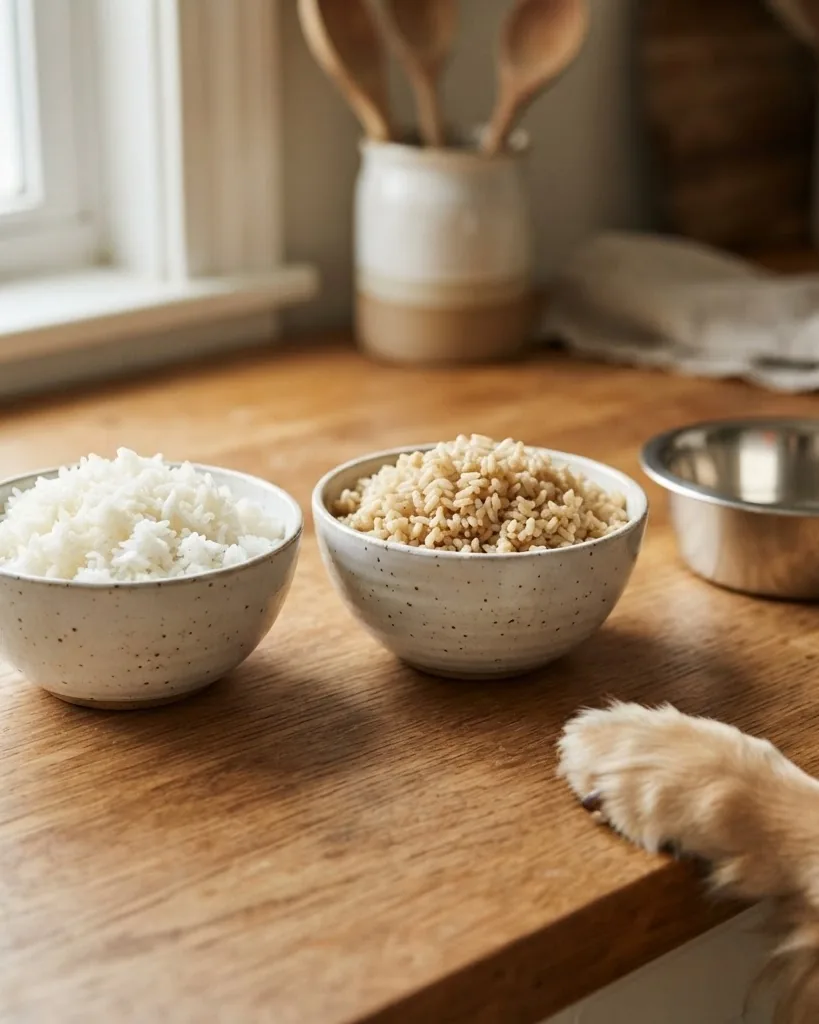
White rice is the standard recommendation for canine digestive upset precisely because it is stripped of the parts that make brown rice look healthier. Brown rice retains its bran layer, which gives it a higher fiber and nutrient content, but that same bran layer makes it comparatively harder for a dog’s gastrointestinal tract to digest, according to the American Kennel Club. When a dog’s gut is already irritated, more fiber is the opposite of what you want. White rice cooks down into a soft, low-residue starch that passes through with minimal work, which is why it dominates the bland-diet protocol despite being the plainer grain on paper.
That reversal trips up a lot of owners who assume the “whole grain” version must be better. For a healthy dog eating it as an occasional treat, the brown grain is fine and delivers slightly more nutrition. For a dog with loose stool or a sensitive stomach, the white version is the tool.
A few practical distinctions worth keeping straight:
- White rice: lower fiber, faster to digest, preferred during acute upset, higher glycemic impact.
- Brown rice: more fiber and nutrients, harder on an irritated gut, better suited to healthy dogs in moderation.
- Basmati and jasmine: plain and unseasoned, they behave like the white variety; the risk is the seasonings people cook them with, not the grain.
- Wild rice: technically a grass seed, safe plain, but chewier and less commonly used for recovery feeding.
The grain you choose matters less than what you refuse to add. A plain grain becomes a problem the moment it meets a stock cube, a pat of butter, or a spoon of garlic.
How Much Rice Can I Give My Dog? Turning “In Moderation” Into a Number
The honest answer to how much rice a dog can eat starts with a single guardrail: treats and supplementary foods, this cooked staple included, should make up no more than approximately 10 percent of a dog’s total daily caloric intake, according to the American Kennel Club. That 10 percent ceiling exists so extras do not crowd out the balanced diet doing the real nutritional work. It is calorie-dense for its volume, so it eats into that budget faster than a low-calorie vegetable would. The practical move is to treat it as part of the treat allowance, not as a free add-on layered on top of a full bowl of food.
Because that 10 percent is a percentage of your specific dog’s calories, a toy breed and a working dog are not in the same league. A 3 kg dog and a 35 kg dog fed identical spoonfuls are getting wildly different fractions of their day’s energy.
How to keep it sane without a calculator:
- Weigh your dog and know roughly what they eat per day before adding anything.
- Count it inside the 10 percent treat budget, not outside it, and reduce kibble slightly if you add a meaningful scoop.
- Scale down hard for small breeds; a tablespoon that barely registers for a large dog can be a large slice of a toy dog’s day.
- Confirm portions with your own veterinarian, who can anchor the number to your dog’s actual maintenance calories.
If you are already juggling other starchy add-ins, it helps to see how a different vegetable stacks up on calories and portioning. Our breakdown of what the numbers say about sweet potatoes for dogs uses the same 10 percent logic and makes a useful side-by-side.
The Bland-Diet Protocol: The 2-to-1 Ratio and When It Stops Working
The bland diet is where rice does its most famous work, and it has a specific recipe. The standard ratio recommended for dogs with mild gastrointestinal upset is approximately 2 to 3 parts cooked, plain white rice to 1 part boiled, unseasoned lean protein such as chicken breast, according to PetMD. Everything must be plain: no salt, no oil, no butter, and absolutely nothing from the onion or garlic family, which are toxic to dogs. It provides gentle, digestible energy while the lean protein keeps the meal from being pure starch. Fed in small, frequent portions, this combination gives an irritated gut something easy to process while the underlying irritation settles.
The part most owners miss is that a bland diet is a bridge, not a destination. The World Small Animal Veterinary Association’s Global Nutrition Guidelines advise transitioning home-prepared or bland recovery diets back to a complete and balanced commercial or veterinarian-formulated diet as soon as clinically appropriate, rather than continuing indefinitely. A rice-and-chicken mix keeps a dog comfortable, but it does not meet full nutrient needs, so it should not become the new normal.
Equally important is knowing when home management is the wrong call. Rice fixes minor, transient upset. It does not fix an emergency, and using it to wait out serious symptoms can cost time a sick dog cannot spare.
Stop and call your veterinarian rather than reaching for more rice if you see:
- Blood in the stool or vomit, or black, tarry stool.
- Marked lethargy, weakness, or collapse.
- Signs of dehydration such as tacky gums or persistent refusal to drink.
- Vomiting or diarrhea that continues beyond 24 to 48 hours despite a bland diet.
When symptoms are mild and your dog is otherwise bright, the bland diet is reasonable first aid. When they are not, rice is a delay, not a treatment. Sudden changes in thirst can accompany gut trouble too, and if your dog is drinking oddly it is worth reading our complete owner triage guide to excessive thirst alongside this one.
Diabetic, Overweight, and Pancreatitis Dogs: Where the Rice Advice Flips
Rice stops being a neutral food the moment a dog has a metabolic or weight condition, and this is where generic advice fails owners most. White rice has a high glycemic impact, meaning it raises blood sugar quickly, which is exactly the wrong property for a diabetic dog whose whole management plan depends on stable glucose. For an overweight or obese dog, its calorie density works against a weight-loss plan, quietly filling part of the day’s energy budget with carbohydrate that offers no protein or essential fat. For these dogs, the default answer shifts from “occasionally fine” to “check first, and usually skip.”
Each condition changes the calculus for a different reason:
- Diabetes: white rice’s rapid glucose rise complicates insulin timing and dosing, so any carbohydrate additions belong in a plan set with a veterinarian.
- Obesity: rice adds calories without satiety-heavy protein, making it easy to blow past the 10 percent extras ceiling on a body that needs a deficit.
- Pancreatitis: plain rice is low in fat, but it should be paired only with low-fat protein and never with oil, butter, or fatty meats.
- Chronic kidney disease: phosphorus and the protein-to-calorie balance in these dogs are tightly managed, so rice belongs inside a therapeutic diet designed by a vet, not a home guess.
There is one situation where rice becomes genuinely useful for a sick dog: elimination diets. It is a relatively uncommon allergen, which is why it appears in some hypoallergenic and elimination protocols used to hunt down a food allergy. Even there, the diet is structured by a professional, not improvised.
Sodium is the other hidden variable for dogs with heart or kidney disease, and it is one more reason plain rice matters: adding salt or stock can undo a carefully restricted diet. Owners managing that balance will find our guide on when low sodium dog food helps versus hurts a useful companion for reading labels.

Arsenic, Storage, and the Long-Term Risk Almost No One Mentions
The one rice risk that competing pet-food articles routinely skip is arsenic, and it only matters for dogs eating it regularly rather than as an occasional treat. This grain has a documented tendency to accumulate more inorganic arsenic from soil and water than most other grains. The U.S. Food and Drug Administration has established a guidance and action level of 100 parts per billion of inorganic arsenic specifically in infant rice cereal, a benchmark that exists precisely because the grain concentrates this contaminant. Brown rice, which keeps its bran layer, tends to hold more than white. For a small dog fed it daily over months, dietary variety is the sensible hedge; for the dog who gets a spoonful now and then, the risk is low.
You do not need to abandon rice over this. You need to stop treating it as a daily forever-food and take two cheap precautions when you do cook it.
Practical arsenic mitigation is simple:
- Rinse rice thoroughly before cooking to wash off surface residue.
- Cook with a generous water-to-rice ratio rather than the minimum absorption method.
- Rotate grains over time so no single ingredient carries the whole carbohydrate load.
Bacterial safety is the more immediate everyday concern. Cooked rice left at room temperature is a known medium for bacterial growth, so it should be refrigerated promptly and used within a few days rather than left in a warm kitchen. This is the same food-safety discipline you would apply to your own leftovers, and it matters more for a dog whose gut is already unsettled. Reputable sourcing and clean storage do more day-to-day than any single-ingredient scare.
Rice in Commercial Dog Food and the Preparations That Make It Dangerous
Rice is not just a home remedy; it is a workhorse ingredient in commercial diets, and understanding why explains a lot. Manufacturers use it because it is a digestible, palatable, energy-dense carbohydrate that binds well in extruded kibble, and rice-containing complete diets are formulated to be nutritionally sound. That is a different thing from feeding it on its own. Pet foods sold as a sole source of nutrition must be substantiated as complete and balanced through AAFCO nutrient-profile formulation or AAFCO-recognized feeding trials, and the FDA requires that any “complete and balanced” label claim be backed by one of those recognized methods. Rice alone meets none of it.
On a label, rice hides under several names worth recognizing: rice, brewers rice, broken rice, and rice flour all point to the same base grain in different forms. Seeing it on an ingredient list is not a red flag; it is a common, validated carbohydrate.
The real danger is not the grain but the dishes people make from it. Several everyday rice preparations range from unbalanced to outright toxic:
- Fried rice: loaded with oil, salt, and often onion or garlic, all of which are unsafe.
- Seasoned or instant rice: flavor packets frequently contain onion or garlic powder.
- Rice cooked in broth: stock commonly contains onion, garlic, and heavy sodium.
- Sushi rice with soy sauce or raw fish: high salt plus parasite and bacterial risk.
- Rice pudding: sugar and dairy, with potential nutmeg toxicity depending on the recipe.
The rule that ties it together: safe rice for dogs is the boring kind. If a person would find it bland, a dog can probably have it; if it smells seasoned, it stays on your plate. For a deeper look at how “safe base food, dangerous preparation” plays out with another kitchen staple, our piece on what corn kernels, cobs, and the numbers really say follows the exact same logic.
The Authorities and What Each One Actually Governs
Food-safety advice for dogs is only as good as the bodies behind it, and several distinct organizations shape what “safe” means, each with a different job. Knowing who governs what helps you weigh advice and spot the difference between a marketing claim and a regulated standard. Below are the groups whose figures and guidelines anchor responsible rice feeding, and the specific role each plays in the chain from a bag of kibble to the spoon of recovery rice in your kitchen. None of them regulate a single home meal, but together they define the boundaries that home feeding should respect.
The American Kennel Club produces the owner-facing nutrition education most people encounter first, including the 10 percent treat guideline and the white-versus-brown rice digestibility distinction. PetMD supplies veterinarian-reviewed consumer guidance such as the bland-diet ratio. Neither is a regulator; both translate clinical consensus into plain language.
The standard-setters sit behind them:
- Association of American Feed Control Officials: establishes the nutrient profiles and the “complete and balanced” labeling standard that governs U.S. pet food formulation.
- U.S. Food and Drug Administration, Center for Veterinary Medicine: regulates pet food safety and labeling, and requires that “complete and balanced” claims be substantiated.
- World Small Animal Veterinary Association: issues the Global Nutrition Guidelines used internationally to assess diet adequacy and home-feeding risk.
- Pet Poison Helpline: the emergency reference for toxic ingredients such as the onion and garlic that ruin so many rice dishes.
What does this cost the owner in practice? Not a fee, but discipline. The AAFCO standard means you cannot safely build a long-term homemade diet around this grain without formal veterinary formulation, because meeting amino-acid, vitamin, and mineral minimums by guesswork is not realistic. The WSAVA guideline that recovery diets be transitioned back promptly means it is a short-term expense of effort, not a permanent shortcut around buying a balanced diet. And the FDA’s arsenic benchmark means the true “cost” of feeding it daily to a small dog is the risk you take on by skipping variety. You can read the FDA’s own material on arsenic in food including rice, the labeling rules under selecting pet food, and the WSAVA Global Nutrition Guidelines directly.
Frequently Asked Questions
Can puppies eat rice?
A small amount of plain, cooked white rice is generally safe for a healthy puppy, and vets sometimes use it in the bland diet for mild upset. The bigger caution is nutrition: puppies have high, precise growth requirements, so it must never displace a complete and balanced puppy food. Keep it occasional, keep it plain, and confirm with your veterinarian before feeding a young or unwell puppy.
Can dogs eat rice every day?
Occasional plain rice is fine, but eating it daily as a routine add-on is not ideal. It counts against the roughly 10 percent treat ceiling the American Kennel Club recommends, and it concentrates more inorganic arsenic than most grains, so long-term daily feeding warrants dietary variety. It is also not complete and balanced on its own, meaning a rice-heavy daily habit slowly shortchanges nutrients your dog needs.
Can dogs eat uncooked rice?
No, dogs should not eat uncooked rice. It is hard, difficult to digest, and can cause gastrointestinal discomfort, gas, or bloating because a dog’s gut is not built to break down the uncooked starch efficiently. Always serve it fully cooked, soft, and plain, with no salt, oil, butter, onion, or garlic. If your dog snatches a few dry grains, watch for stomach upset.
Is rice good for a dog’s upset stomach?
Plain white rice is a classic tool for mild gastrointestinal upset, usually mixed at roughly 2 to 3 parts rice to 1 part boiled lean protein per PetMD. It is low-residue and easy to digest, giving an irritated gut a break. It is short-term first aid, not a cure, so transition back to a balanced diet quickly and call your vet if you see blood, lethargy, or symptoms lasting beyond 24 to 48 hours.
Can dogs eat rice and eggs together?
Yes, plain cooked rice with a plain scrambled or boiled egg, cooked without salt, butter, oil, onion, or garlic, is a safe and gentle combination many owners use for recovery feeding. The egg adds easily digestible protein to its gentle carbohydrate. Keep portions modest within the 10 percent extras guideline, and skip it for dogs on fat-restricted or condition-specific diets unless your veterinarian approves.
How much rice is too much for a dog?
Rice becomes too much once it, combined with all other treats, exceeds roughly 10 percent of your dog’s daily calories, the ceiling cited by the American Kennel Club. For small breeds that threshold arrives fast, so scale portions to body weight rather than using a fixed spoon count. Overfeeding it also risks weight gain and, for diabetic dogs, blood-sugar spikes from its high glycemic impact.
The Bottom Line on Feeding Rice
Rice is a genuinely useful food for dogs when you respect its limits: plain and cooked, capped inside the 10 percent extras budget, deployed as a short bland-diet bridge rather than a permanent staple, and reconsidered entirely for diabetic, overweight, and chronically ill dogs. Keep the grain boring, keep the portions weight-appropriate, rotate it for dogs on long-term feeding schedules, and escalate to your veterinarian the moment symptoms turn serious. Treated that way, a spoonful of white rice is one of the safest, gentlest things you can hand your dog. For related feeding questions, our guides on the numbers and dose behind pumpkin seeds for dogs and a vet-informed safety and serving guide for shrimp apply the same evidence-first approach.